
Ella Fitzgerald
What'S Your Story, Morning Glory
Recorded by Ella Fitzgerald
Ella Fitzgerald
What'S Your Story, Morning Glory
Recorded by Ella Fitzgerald
- Besetzung Big Band mit Gesang
- Interpret Ella Fitzgerald
- Bearbeiter Marty Paich
- Herausgeber Jeff Sultanof Rob DuBoff
-
Schwierigkeit
- Ausgabe Partitur und Stimmen
- Verlag Jazz Lines Publications
- Bestell-Nr. JLP-9613

Beschreibung:
It should come as no surprise that Marty Paich was chosen to write the arrangements for the 1958 album 'Ella Swings Lightly.' Paich's 'dektette' writing for Mel Tormé had brought him some of his earliest acclaim, and he would go on to be the architect behind the back up band for alto saxophonist Art Pepper's classic 'Art Pepper Plus Eleven' in 1960. Although this is a fairly simple arrangement when all is said and done, it does an excellent job of setting the stage for Fitzgerald's stellar vocals throughout. The initial twelve bars evoke a hint of the sound of the Andy Kirk and Jimmie Lunceford bands of the late 1920s and early 1930s. The melody is played in octaves between the clarinet and tenor saxophone beginning at measure 3 and continuing until Fitzgerald's entrance at the pickup to measure 15. The backgrounds under the vocals stay fairly consistent throughout the arrangement, with the same off-beat hits in the brass and cutesy lick in the baritone saxophone. The volume level should never overwhelm the vocalist, although there should be a noticeable crescendo beginning in measure 25 to set up the brief shout chorus at measure 27. The alto saxophone solos over top of the full band playing a very Basie-esque riff before the vocals return with the pickups to measure 31. The final bars of the ensemble hearken back to the introduction, with the melody once again handled by clarinet and tenor saxophone. The introduction and shout section are basically combined together at measure 45, leading to a gradual final ensemble figure before the vocalist poses the titular question one last time. This arrangement is written for little big band including horn in F and tuba. However, alternate parts are included in the event that you don't have access to a horn player. These parts are either trumpet 3 or trombone 2. Alto saxophone doubles on clarinet. The key is G throughout. This publication has been prepared from the original set of parts used during the recording session - this is not a transcription.
Kunden bewerteten diesen Artikel:
Herstellerinformationen:
Jazz Lines Publ.
PO Box 1236
NY 12866
Saratoga Spgs
Vereinigte Staaten
Andere Kunden kauften auch:
An Engaging Way to Practice Scale Patterns and Etudes While Learning Jazz
- Klavier
- Noten
-
 auf Lager
Lieferzeit 1-3 Arbeitstage
- Klavier
- Noten
-
auf Lager
Lieferzeit 1-3 Arbeitstage


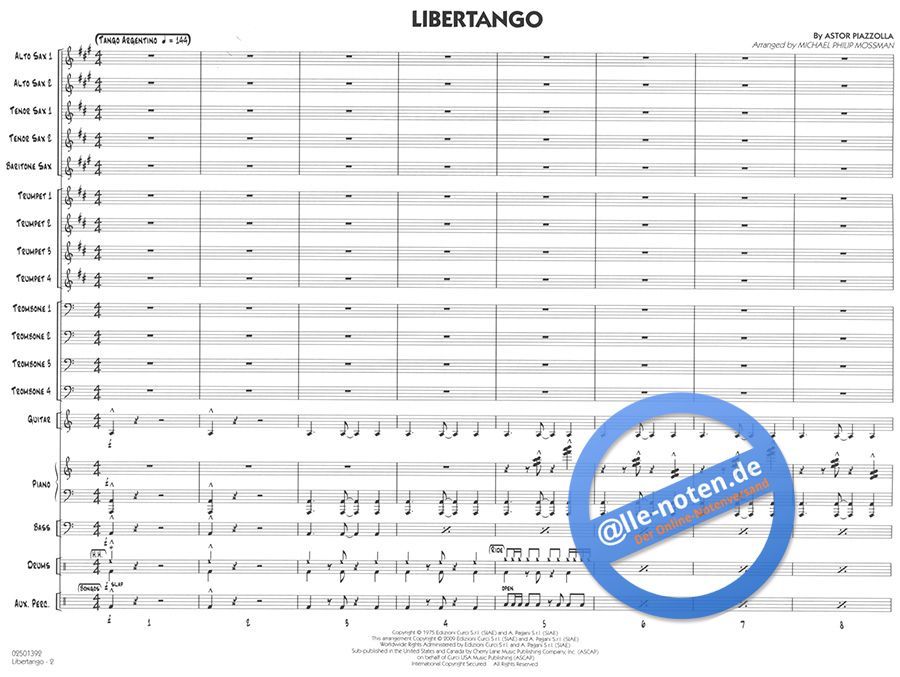
Astor Piazzolla
- Big Band
- Partitur und Stimmen
- Michael Philip Mossman
-
auf Lager
Lieferzeit 1-3 Arbeitstage - Auch als Download verfügbar!
- Klavier
- Noten
-
Lieferzeit 1-2 Wochen