
Dorothea Hofmann
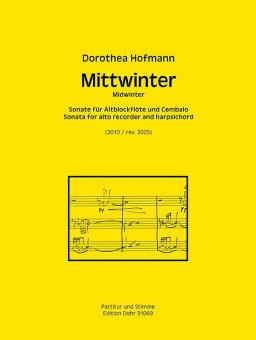
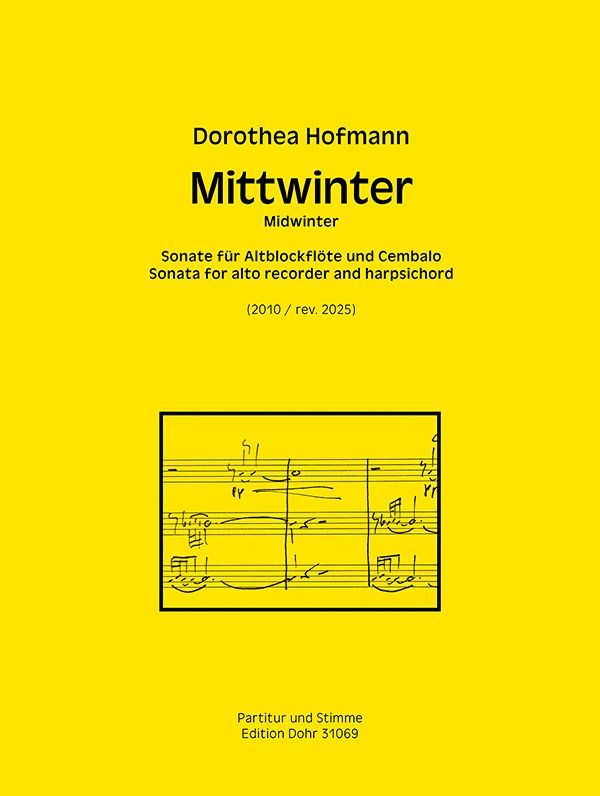
Mittwinter
Sonate für Altblockflöte und Cembalo (2010/2025)
NEU
Dorothea Hofmann
Mittwinter
Sonate für Altblockflöte und Cembalo (2010/2025)
- Besetzung Altflöte und Cembalo
- Komponist Dorothea Hofmann
- Ausgabe Partitur und Stimmen
- Verlag Musikverlag Christoph Dohr
- Bestell-Nr. DOHR31069
 Lieferzeit 2-5 Arbeitstage
inkl. MwSt.,
zzgl. Versand
Nicht in allen Ländern verfügbar. Mehr erfahren

Beschreibung:
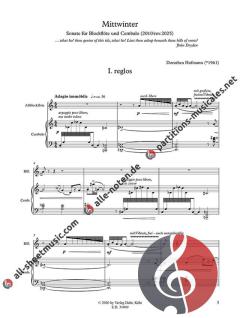
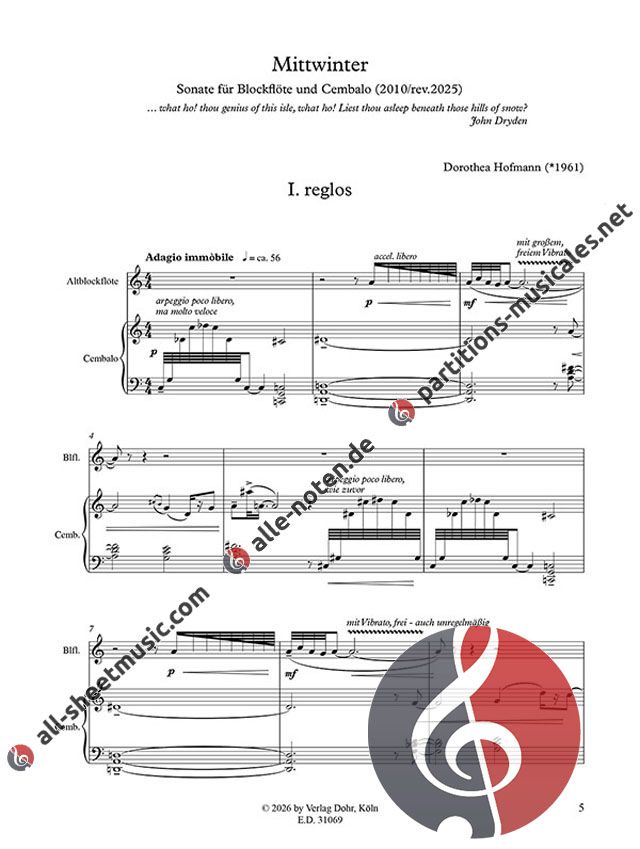
... what ho! thou genius of this isle, what ho!
thou asleep beneath those hills of snow?
(John Dryden, King Arthur, Akt 3, Cupid)
Ein Motto aus einer "Semiopera" von Henry Purcell, auf deren vielleicht berühmteste Szene: den Dialog zwischen Cupido und dem "Cold Genius". Cupido weckt den Cold Genius, der, "unwillingly and slow" zu sich kommend, anfänglich darauf besteht, in seiner Eiseskälte zu verbleiben - "let me freeze again to death". Doch Cupido besteht darauf: "At Love's appearing, All the sky clearing" und überzeugt ihn: "Great Love, I know thee now: Eldest of the gods art thou" - und die Szene endet ganz frühlingshaft: "Love was made for a blessing and not for a pain." Die Sonate hat durchweg eine theatrale Grundhaltung, wie auch jede barocke Instrumentalmusik, sie bedient sich mancher barocker Spielmöglichkeiten wie Triller etc., ohne je wörtlich Barockes zu zitieren und schafft so eine intensive instrumentale Neuinterpretation eines uralten Themas. (Dorothea Hofmann)
thou asleep beneath those hills of snow?
(John Dryden, King Arthur, Akt 3, Cupid)
Ein Motto aus einer "Semiopera" von Henry Purcell, auf deren vielleicht berühmteste Szene: den Dialog zwischen Cupido und dem "Cold Genius". Cupido weckt den Cold Genius, der, "unwillingly and slow" zu sich kommend, anfänglich darauf besteht, in seiner Eiseskälte zu verbleiben - "let me freeze again to death". Doch Cupido besteht darauf: "At Love's appearing, All the sky clearing" und überzeugt ihn: "Great Love, I know thee now: Eldest of the gods art thou" - und die Szene endet ganz frühlingshaft: "Love was made for a blessing and not for a pain." Die Sonate hat durchweg eine theatrale Grundhaltung, wie auch jede barocke Instrumentalmusik, sie bedient sich mancher barocker Spielmöglichkeiten wie Triller etc., ohne je wörtlich Barockes zu zitieren und schafft so eine intensive instrumentale Neuinterpretation eines uralten Themas. (Dorothea Hofmann)