
Yves Tramon
Prelude in the Style of Johann Sebastian Bach
for Solo Horn
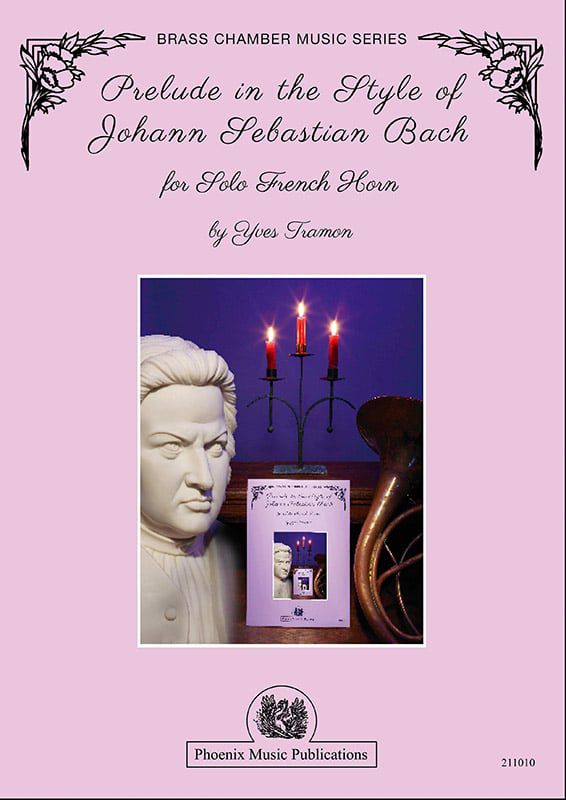
Yves Tramon
Prelude in the Style of Johann Sebastian Bach
for Solo Horn
- Besetzung Horn
- Komponist Yves Tramon
- Ausgabe Noten
- Verlag Phoenix Music NL
- Bestell-Nr. PHOENIXNL211010
 Lieferzeit 4-8 Arbeitstage
inkl. MwSt.,
zzgl. Versand
Nicht in allen Ländern verfügbar. Mehr erfahren

Beschreibung:
The Six Suites for Solo Cello by Johan-Sebastian Bach are a pinnacle of cello literature. So much so that they have been adapted for all instruments. There are at least three different versions for the horn alone (Daniel Bourge through Éditions Billaudot, Francis Orval through Editions Marc Reift and Wendel Hoss through Southern Music Publishing Company). The popularity of these suites is due as much to the depth and intensity of the musical message as to their sometimes formidable technical difficulties, which constitute a challenge for even seasoned instrumentalists.
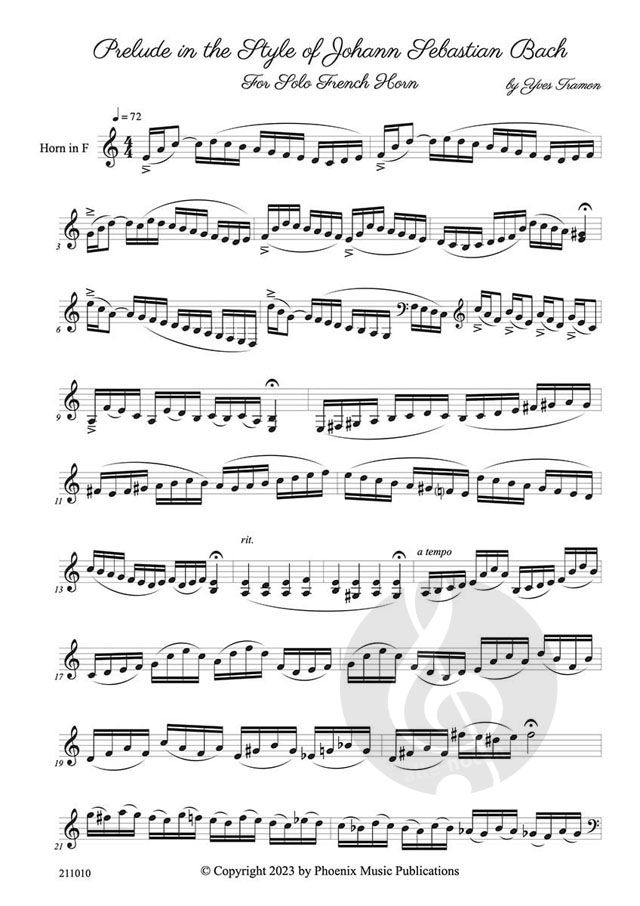
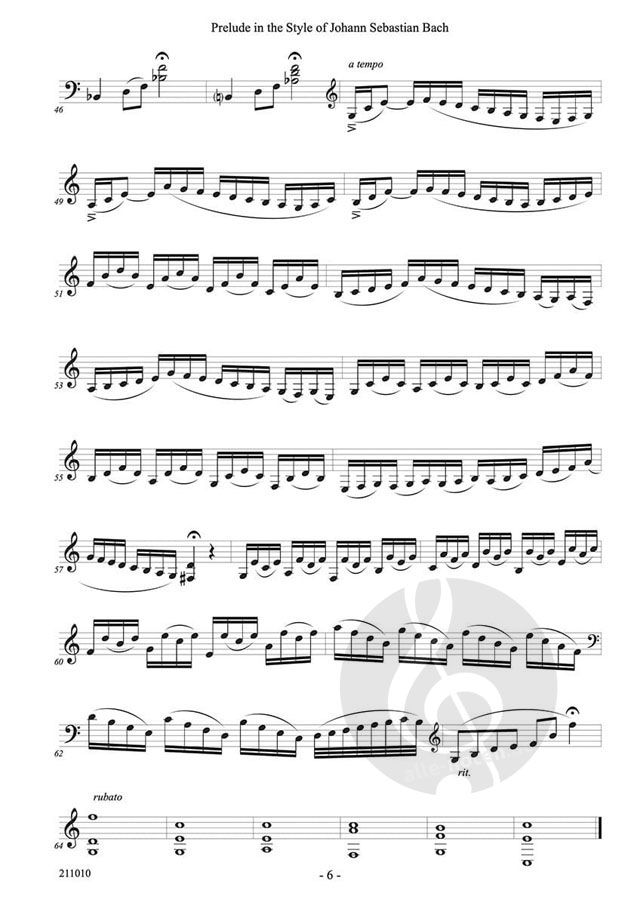
Through this free-form prelude, as conceived by Bach, I sought to rediscover the spirit of the Leipzig Cantor’s writing. And to adapt it to our instrument, such as JS Bach himself could have achieved if he had been familiar in his time with our modern horn. To achieve this, I used arpeggios and multiphonics as he employed in his instrumental writing for the cello. But also with the addition of stopped notes specific to the horn, which widens the range of colours.
BREATHING
Breathing is an important aspect for any wind instrumentalist approaching the cello suites whose importance Bach could not have suspected. This is true for brass players more generally since the phrases sometimes follow each other in continuous sixteenth notes over an excessive duration. This is why I wanted to create breathing possibilities between phrases, either by using quarter notes or half notes with fermatas, instead of linking them together as Bach could afford to in his writing. Bach’s writing can still pose problems today if one is not sufficiently familiar with the performance practices in force in the 18th century, which allowed breathing through interrupting the continuity of the melodic flow. To be convinced of this, one need only look at his Solo for transverse flute, and particularly at the second part of the initial Allemande, which consists of 25 bars of sixteenth-notes without the slightest interruption.
HARMONICS:
The technique of playing multiple sounding notes, or harmonics, was known as early as the 18th century. The famous Bohemian virtuoso Giovanni Punto was considered a master in this field. He was admired by his contemporaries for being able to play up to four sounds simultaneously.
The technique applies to all brass players: one pitch is played normally while a second is sung. The third pitch (harmonic) results naturally (if done correctly) from the difference between the other two. Even a fourth harmonic is possible, resulting from the sum of the first two in accordance with an immutable physical law. The order of which pitches one plays and sings has little importance. It depends on the vocal range of the player and the range of the played note, obtaining the third pitch. However, the third note is necessarily a function of the other two. That is to say: we cannot obtain any third note we want. It is conditional to the other two. For example, play a low “C” and sing the “G” two octaves higher, you will hear the harmonic “E”.
The multiphonics of Carl Maria von Weber’s cadenza in his Concertino are therefore impossible to perform as written. They do not correspond to what can be achieved in acoustical physics. This acoustic phenomenon can be easily verified by playing high-pitched sounds with two high-pitched instruments such as flutes or trumpets. Provided you play perfectly in-tune intervals, you can hear a third pitch quite distinctly through this resonance effect. This can be verified on a piano by playing intervals of thirds, fourths, fifths or sixths in the upper register while depressing the sustain pedal.
SECRET
The secret to making these harmonics audible is to project your voice far enough INTO the instrument. Make sure that it projects clearly out of the horn bell. Make sure that your voice does not remain in your own mouth. Otherwise it will not be balanced with the sound being played and the harmonic will not resonate.
May you have as much pleasure playing and interpreting this prelude as I have had in writing it!
- Yves Tramon
Through this free-form prelude, as conceived by Bach, I sought to rediscover the spirit of the Leipzig Cantor’s writing. And to adapt it to our instrument, such as JS Bach himself could have achieved if he had been familiar in his time with our modern horn. To achieve this, I used arpeggios and multiphonics as he employed in his instrumental writing for the cello. But also with the addition of stopped notes specific to the horn, which widens the range of colours.
BREATHING
Breathing is an important aspect for any wind instrumentalist approaching the cello suites whose importance Bach could not have suspected. This is true for brass players more generally since the phrases sometimes follow each other in continuous sixteenth notes over an excessive duration. This is why I wanted to create breathing possibilities between phrases, either by using quarter notes or half notes with fermatas, instead of linking them together as Bach could afford to in his writing. Bach’s writing can still pose problems today if one is not sufficiently familiar with the performance practices in force in the 18th century, which allowed breathing through interrupting the continuity of the melodic flow. To be convinced of this, one need only look at his Solo for transverse flute, and particularly at the second part of the initial Allemande, which consists of 25 bars of sixteenth-notes without the slightest interruption.
HARMONICS:
The technique of playing multiple sounding notes, or harmonics, was known as early as the 18th century. The famous Bohemian virtuoso Giovanni Punto was considered a master in this field. He was admired by his contemporaries for being able to play up to four sounds simultaneously.
The technique applies to all brass players: one pitch is played normally while a second is sung. The third pitch (harmonic) results naturally (if done correctly) from the difference between the other two. Even a fourth harmonic is possible, resulting from the sum of the first two in accordance with an immutable physical law. The order of which pitches one plays and sings has little importance. It depends on the vocal range of the player and the range of the played note, obtaining the third pitch. However, the third note is necessarily a function of the other two. That is to say: we cannot obtain any third note we want. It is conditional to the other two. For example, play a low “C” and sing the “G” two octaves higher, you will hear the harmonic “E”.
The multiphonics of Carl Maria von Weber’s cadenza in his Concertino are therefore impossible to perform as written. They do not correspond to what can be achieved in acoustical physics. This acoustic phenomenon can be easily verified by playing high-pitched sounds with two high-pitched instruments such as flutes or trumpets. Provided you play perfectly in-tune intervals, you can hear a third pitch quite distinctly through this resonance effect. This can be verified on a piano by playing intervals of thirds, fourths, fifths or sixths in the upper register while depressing the sustain pedal.
SECRET
The secret to making these harmonics audible is to project your voice far enough INTO the instrument. Make sure that it projects clearly out of the horn bell. Make sure that your voice does not remain in your own mouth. Otherwise it will not be balanced with the sound being played and the harmonic will not resonate.
May you have as much pleasure playing and interpreting this prelude as I have had in writing it!
- Yves Tramon