
Thierry Escaich
Concerto pour clarinette
Réduction
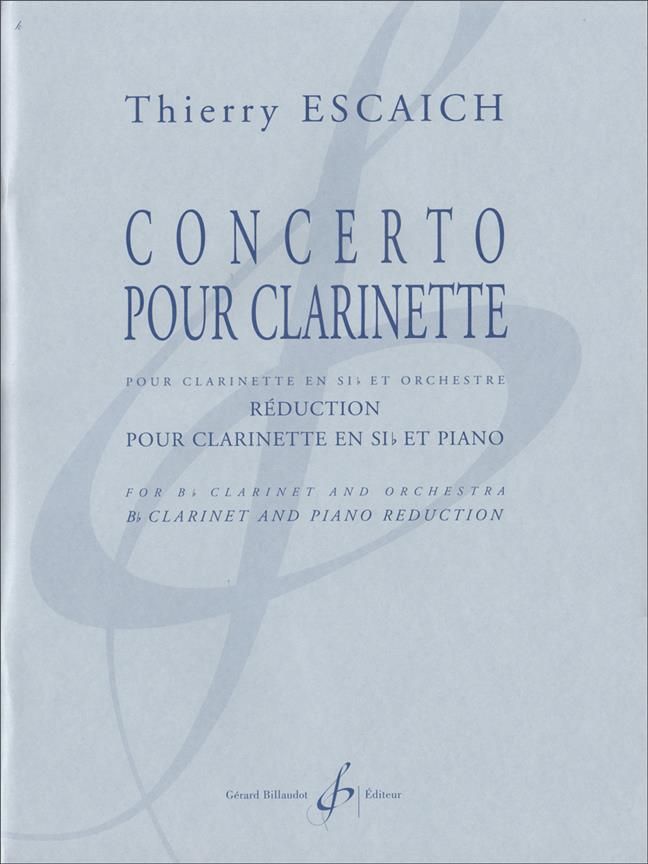
Thierry Escaich
Concerto pour clarinette
Réduction
- Besetzung Klarinette und Klavier
- Komponist Thierry Escaich
- Ausgabe Klavierauszug
- Verlag Gerard Billaudot
- Bestell-Nr. BILL9244
 Lieferzeit 4-8 Arbeitstage
inkl. MwSt.,
zzgl. Versand
Nicht in allen Ländern verfügbar. Mehr erfahren

Beschreibung:
Sound matter circulating endlessly within the orchestra, manifold echoes that spring up on all sides, a search for sound textures of the most diverse colours: these are what characterise this concerto above all, a concertant symphonic poem unfolding without a break despite being structured in three movements.
The first opens with sound spaces of dark, disturbing colours from which the clarinet emerges before spreading in multiple echoes amongst the orchestra's winds. Between these ebbs and flows accentuated by massive repeated chords, the clarinet progressively imposes melismas with neo-Baroque contours before a more motoric section begins, in a constant crescendo, led by a haunting hammering of staccatissimo motifs.
Following a transition in which the discourse becomes calmer, the second movement begins with a long descending clarinet melody, punctuated by a chromatic accompaniment slowly marked out on the piano. This melody seems to carry on a dialogue with its double in an entanglement of contrapuntal lines, as if we were watching Renaissance polyphonies unfurling in the distance. After an expressive reinforcement of this more melodic episode, a long passacaglia begins with a mechanical, almost burlesque, theme distributed to the whole orchestra as in a gigantic Klangfarbenmelodie (melody of timbres). In the course of its different variations, this theme will exploit a host of instrumental combinations between the clarinet and instrumental groups of the orchestra (such as the muted brass or the percussion), in the spirit of a concerto grosso perpetually renewed, going from jazzy reminiscences to Expressionistic gusts.
(Thierry Escaich)
Translated by John Tyler Tuttle
The first opens with sound spaces of dark, disturbing colours from which the clarinet emerges before spreading in multiple echoes amongst the orchestra's winds. Between these ebbs and flows accentuated by massive repeated chords, the clarinet progressively imposes melismas with neo-Baroque contours before a more motoric section begins, in a constant crescendo, led by a haunting hammering of staccatissimo motifs.
Following a transition in which the discourse becomes calmer, the second movement begins with a long descending clarinet melody, punctuated by a chromatic accompaniment slowly marked out on the piano. This melody seems to carry on a dialogue with its double in an entanglement of contrapuntal lines, as if we were watching Renaissance polyphonies unfurling in the distance. After an expressive reinforcement of this more melodic episode, a long passacaglia begins with a mechanical, almost burlesque, theme distributed to the whole orchestra as in a gigantic Klangfarbenmelodie (melody of timbres). In the course of its different variations, this theme will exploit a host of instrumental combinations between the clarinet and instrumental groups of the orchestra (such as the muted brass or the percussion), in the spirit of a concerto grosso perpetually renewed, going from jazzy reminiscences to Expressionistic gusts.
(Thierry Escaich)
Translated by John Tyler Tuttle
Kunden bewerteten diesen Artikel:
Herstellerinformationen:
Gérard Billaudot Éditeur, S.A.S.
14, rue de l’Échiquier
75010
Paris
Deutschland
Andere Kunden kauften auch:

Herbert Baumann
- Klarinette und Streicher
- Einzelstimme Klarinette Solo
-
Lieferzeit 4-8 Arbeitstage
- Klarinette und Orchester
- Einzelstimme Klarinette Solo
-
Lieferzeit 2-4 Wochen