
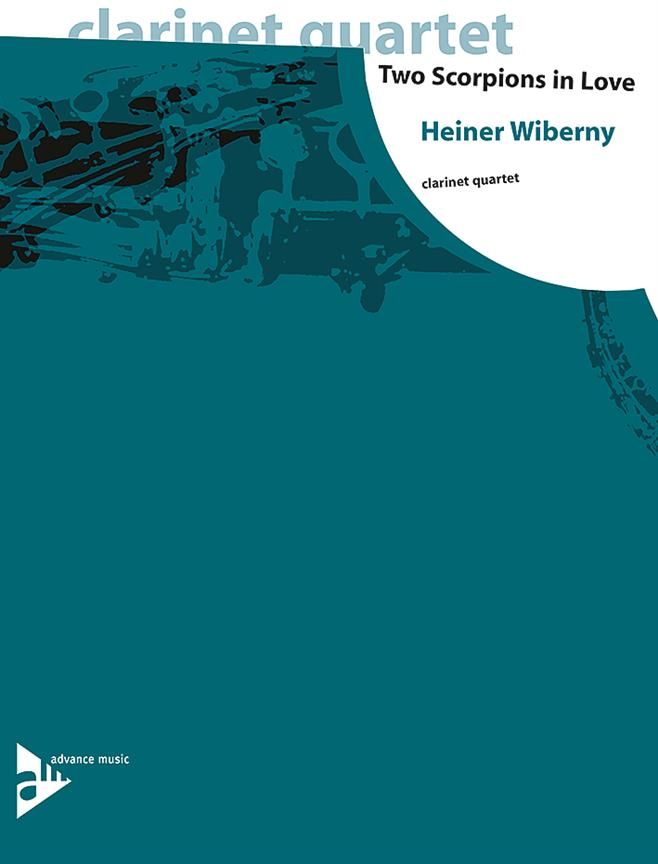
Heiner Wiberny
Two Scorpions in Love
PDF
ansehen
Heiner Wiberny
Two Scorpions in Love
- Besetzung Klarinettenquartett
- Komponist Heiner Wiberny
-
Schwierigkeit
- Ausgabe Partitur und Stimmen
- Verlag Advance Music
- Bestell-Nr. ADV08443
 auf Lager
Lieferzeit 1-3 Arbeitstage
inkl. MwSt.,
zzgl. Versand
Nicht in allen Ländern verfügbar. Mehr erfahren

Beschreibung:
Clarinet Quartet
(Bb Clarinet 1-2, Eb Alto Clarinet (sub. Bb Clarinet), Bass Clarinet)
I wrote this joyful and swinging jazz waltz for my son Julian and his girlfriend Nina, both born under the sign of Scorpio. The piece is
made up of the following parts:
Fanfare-like intro, ABAC - theme, D - solo part designed
for the principal clarinet, E and F - solo part designed for
the alto clarinet or the third clarinet; the respective soloists may
either perform the solo transcriptions I included in the arrangement
or improvise freely. Parts D, E and F - measures 47 through 83 - can be repeated after the solos in case a free improvisation is opted for, followed by part G, a transitional passage. This bridge then leads up to a dal segno calling for a repetition of parts ABAB and,
finally, to the coda bringing the piece to an end.
Here some additional recommendations:
When interpreting this waltz, attention has to be paid to the
execution of the swinging eighth notes and the accents; the duration
of the latter should invariably coincide with the value of the respective notes. Rhythmic accuracy in ensemble playing can be achieved by
permanently being aware of the flow of eighth notes as well as by
consciously correlating one's own voice with the partly varying
phrases executed by the other players. Thus, it is possible to give
the necessary 'push' to accents jointly executed by all the clarinets. Therefore, I recommend repeating individual measures at a
slower tempo until their rhythmic structure becomes clear and evident - an approach which, incidentally, is also conducive to
developing a good intonation. Have fun! Heiner Wiberny
(Bb Clarinet 1-2, Eb Alto Clarinet (sub. Bb Clarinet), Bass Clarinet)
I wrote this joyful and swinging jazz waltz for my son Julian and his girlfriend Nina, both born under the sign of Scorpio. The piece is
made up of the following parts:
Fanfare-like intro, ABAC - theme, D - solo part designed
for the principal clarinet, E and F - solo part designed for
the alto clarinet or the third clarinet; the respective soloists may
either perform the solo transcriptions I included in the arrangement
or improvise freely. Parts D, E and F - measures 47 through 83 - can be repeated after the solos in case a free improvisation is opted for, followed by part G, a transitional passage. This bridge then leads up to a dal segno calling for a repetition of parts ABAB and,
finally, to the coda bringing the piece to an end.
Here some additional recommendations:
When interpreting this waltz, attention has to be paid to the
execution of the swinging eighth notes and the accents; the duration
of the latter should invariably coincide with the value of the respective notes. Rhythmic accuracy in ensemble playing can be achieved by
permanently being aware of the flow of eighth notes as well as by
consciously correlating one's own voice with the partly varying
phrases executed by the other players. Thus, it is possible to give
the necessary 'push' to accents jointly executed by all the clarinets. Therefore, I recommend repeating individual measures at a
slower tempo until their rhythmic structure becomes clear and evident - an approach which, incidentally, is also conducive to
developing a good intonation. Have fun! Heiner Wiberny
Kunden bewerteten diesen Artikel:
Herstellerinformationen:
Advance Music
Weihergarten 5
55116
Mainz
Deutschland
Verwandte Artikel:

- Saxophonquartett
- Partitur und Stimmen
- Advance Music
-
-
auf Lager
Lieferzeit 1-3 Arbeitstage
Andere Kunden kauften auch:
Bert Kaempfert
- Akkordeon und Instrument in B
- Noten
-
Lieferzeit 2-4 Arbeitstage
- Klavier
- Noten
-
Lieferzeit 2-4 Arbeitstage

- Klavier
- Noten
-
Lieferzeit 2-4 Arbeitstage