
Christoph Enzel
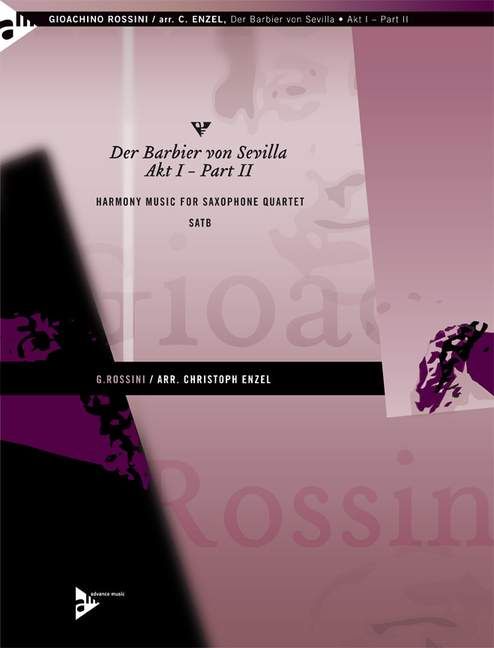
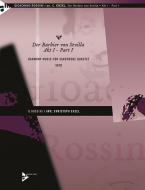
Der Barbier von Sevilla Akt I - Teil II
PDF
ansehen
Christoph Enzel
Der Barbier von Sevilla Akt I - Teil II
- Besetzung Saxophonquartett
- Komponist Christoph Enzel
-
Schwierigkeit
- Ausgabe Partitur und Stimmen
- Verlag Advance Music
- Bestell-Nr. ADV07471
 auf Lager
Lieferzeit 1-3 Arbeitstage
inkl. MwSt.,
zzgl. Versand
Nicht in allen Ländern verfügbar. Mehr erfahren
Beschreibung:
Saxophone Quartet (SATB)
Includes: Cavatina ''Largo Al Factotum'', Duetto ''All' idea Quel Metallo'', Cavatina ''Una Voce Poco Fa''
Harmoniemusik - Music for Wind Instruments arranged for SaxophoneQuartet in Four Volumes
Dating back to circa 1770, 'Harmoniemusik' - music for wind instruments -was originally conceived for wind orchestras.
Scored for wood and brass instruments, it was mainly performed at open-air concerts and as 'Tafelmusik' (table music). The standard instrumentation used to include pairs of oboes, clarinets, horns and bassoons forming a wind octet; the ensemble was often complemented by additional bass instruments such as a double bassoon, a double bass or further wind instruments.
Mostly, it was the composers themselves who arranged their works for wind instruments.
This does not hold true for the original Barber of Seville 'Harmoniemusik'. It was written
by the clarinetist Wenzel Sedlák.
The version on hand takes up 'Harmoniemusik' tradition and transposes the magnifi cent melodies of this opera into a contemporary musical setting via saxophone quartet.
Includes: Cavatina ''Largo Al Factotum'', Duetto ''All' idea Quel Metallo'', Cavatina ''Una Voce Poco Fa''
Harmoniemusik - Music for Wind Instruments arranged for SaxophoneQuartet in Four Volumes
Dating back to circa 1770, 'Harmoniemusik' - music for wind instruments -was originally conceived for wind orchestras.
Scored for wood and brass instruments, it was mainly performed at open-air concerts and as 'Tafelmusik' (table music). The standard instrumentation used to include pairs of oboes, clarinets, horns and bassoons forming a wind octet; the ensemble was often complemented by additional bass instruments such as a double bassoon, a double bass or further wind instruments.
Mostly, it was the composers themselves who arranged their works for wind instruments.
This does not hold true for the original Barber of Seville 'Harmoniemusik'. It was written
by the clarinetist Wenzel Sedlák.
The version on hand takes up 'Harmoniemusik' tradition and transposes the magnifi cent melodies of this opera into a contemporary musical setting via saxophone quartet.
Kunden bewerteten diesen Artikel:
Herstellerinformationen:
Advance Music
Weihergarten 5
55116
Mainz
Deutschland
Verwandte Artikel:
- Saxophonquartett (SATB)
- Partitur und Stimmen
- Advance Music
-
-
auf Lager
Lieferzeit 1-3 Arbeitstage
- Saxophonquartett (SATB)
- Partitur und Stimmen
- Advance Music
-
-
auf Lager
Lieferzeit 1-3 Arbeitstage
- Saxophonquartett
- Partitur und Stimmen
- Advance Music
-
-
auf Lager
Lieferzeit 1-3 Arbeitstage