
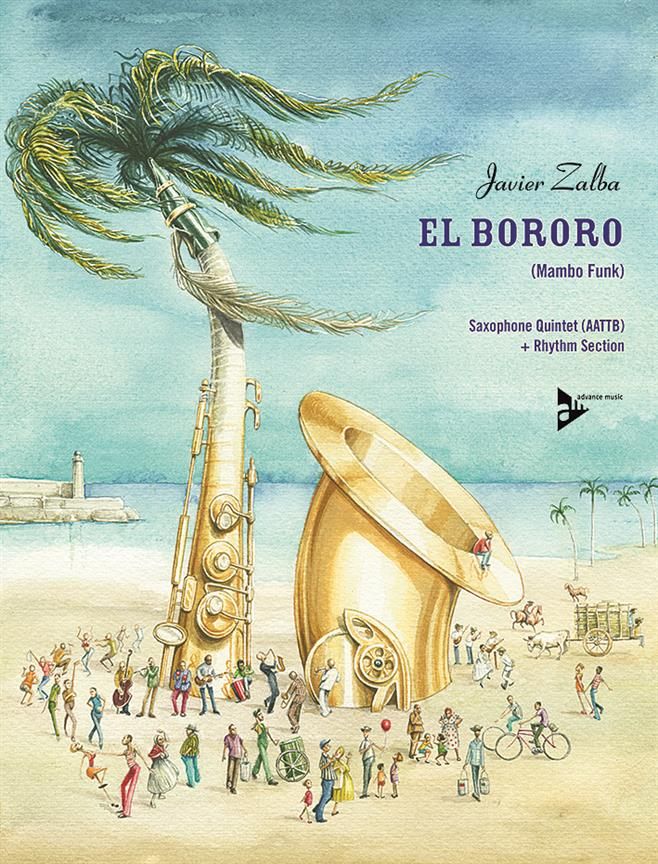
Javier Zalba
El Bororo
Mambo Funk
PDF
ansehen
Javier Zalba
El Bororo
Mambo Funk
- Besetzung 5 Saxophone (AATTB) und Rhythmusgruppe
- Komponist Javier Zalba
-
Schwierigkeit
- Ausgabe Partitur und Stimmen
- Verlag Advance Music
- Bestell-Nr. ADV07565
 auf Lager
Lieferzeit 1-3 Arbeitstage
inkl. MwSt.,
zzgl. Versand
Nicht in allen Ländern verfügbar. Mehr erfahren

Beschreibung:
Saxophone Quintet (AATTB) + Rhythm Section (Piano, Double Bass, Conga Drums, Cowbell, Drums)
This mambo-inspired piece of music is dedicated with great affection to Juan Carlos Ledón aka El Bororo', an outstanding Cuban saxophonist, who presently works as a teacher at 'Belén Jesuit Preparatory School' in Miami / USA.
The influence of jazz standards makes itself heavily felt in the piece 'El Bororo'. This does not only become obvious in the solo performed by the saxophones in part C but also in the riff-like effect, which is a common feature of jazz themes. In this piece, the just mentioned effect can be heard in measures 19 through 26, the only difference being that this riff is here being accompanied by the bass drum executing the first and third beats while the cowbell, or cencerro, is strictly keeping time. The influence of jazz also becomes evident during the improvised solos; they may be executed ad libitum and finally close with a piano solo, which is accompanied by a riff played by the saxophones, executing the second and fourth in order to resume the initial theme to finally conclude the piece.
As is the case with any music based on a particular musical style, the actual interpretation of 'El Bororo' should be preceded by the study of representative recordings. With regard to this composition, I recommend listening to the original music created by the 'King of Mambo'.'
This mambo-inspired piece of music is dedicated with great affection to Juan Carlos Ledón aka El Bororo', an outstanding Cuban saxophonist, who presently works as a teacher at 'Belén Jesuit Preparatory School' in Miami / USA.
The influence of jazz standards makes itself heavily felt in the piece 'El Bororo'. This does not only become obvious in the solo performed by the saxophones in part C but also in the riff-like effect, which is a common feature of jazz themes. In this piece, the just mentioned effect can be heard in measures 19 through 26, the only difference being that this riff is here being accompanied by the bass drum executing the first and third beats while the cowbell, or cencerro, is strictly keeping time. The influence of jazz also becomes evident during the improvised solos; they may be executed ad libitum and finally close with a piano solo, which is accompanied by a riff played by the saxophones, executing the second and fourth in order to resume the initial theme to finally conclude the piece.
As is the case with any music based on a particular musical style, the actual interpretation of 'El Bororo' should be preceded by the study of representative recordings. With regard to this composition, I recommend listening to the original music created by the 'King of Mambo'.'
Kunden bewerteten diesen Artikel:
Herstellerinformationen:
Advance Music
Weihergarten 5
55116
Mainz
Deutschland
Andere Kunden kauften auch:
- Saxophonquintett (AATTB/SATTB/SAATB)
- Partitur und Stimmen
-
Lieferzeit 3-6 Arbeitstage
- Saxophonquintett (AATTB)
- Partitur und Stimmen
-
auf Lager
Lieferzeit 1-3 Arbeitstage
Christian Korthals
- Saxophonquintett (AATTB/SATTB)
- Partitur und Stimmen
-
auf Lager
Lieferzeit 1-3 Arbeitstage
Bob Mintzer
- Saxophonquintett (SATTB)
- Noten
-
auf Lager
Lieferzeit 1-3 Arbeitstage
Bob Mintzer
- Saxophonquintett (SATTB)
- Noten
-
auf Lager
Lieferzeit 1-3 Arbeitstage
Jim McNeely
- 5 Saxophone und Klavier (SATTB)
- Noten
-
auf Lager
Lieferzeit 1-3 Arbeitstage
Bob Mintzer
- Saxophonquintett (AATTB)
- Noten
-
auf Lager
Lieferzeit 1-3 Arbeitstage
Frank Reinshagen
- Saxophonquintett (AATTB)
- Partitur und Stimmen
-
auf Lager
Lieferzeit 1-3 Arbeitstage
- Saxophonquintett
- Noten
- Jérôme Naulais
-
Lieferzeit 1-2 Wochen
- Auch als Download verfügbar!

- Saxophonquintett (AATTB)
- Partitur und Stimmen
-
auf Lager
Lieferzeit 1-3 Arbeitstage