
Michael Jarrell
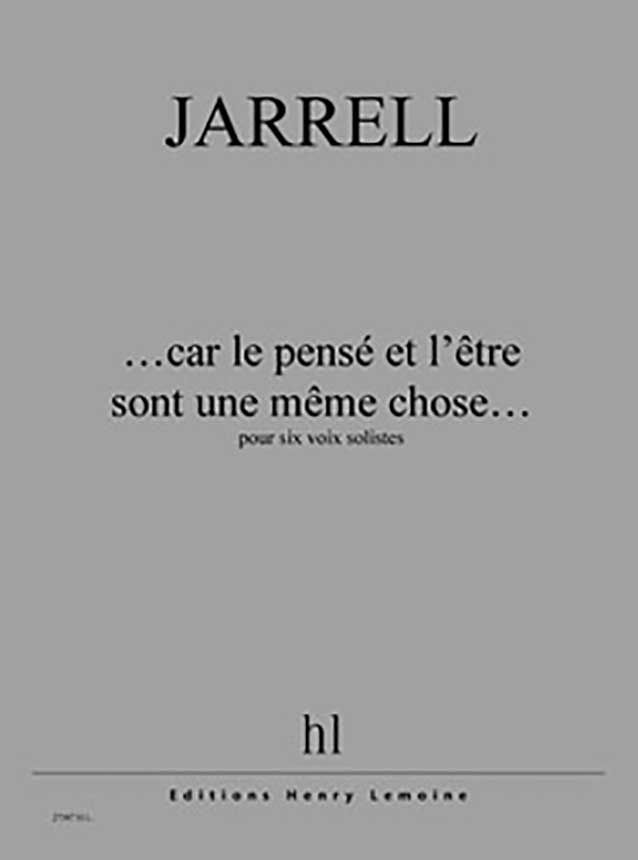
...car le pensé et l'etre sont une meme chose...
PDF
ansehen
Michael Jarrell
...car le pensé et l'etre sont une meme chose...
- Besetzung 6 Soli
- Komponist Michael Jarrell
- Ausgabe Noten
- Verlag Editions Henry Lemoine
- Bestell-Nr. LEMO27587
 Lieferzeit 4-8 Arbeitstage
inkl. MwSt.,
zzgl. Versand
Nicht in allen Ländern verfügbar. Mehr erfahren

Beschreibung:
The literary text, present in ...car le pensé et l'être sont une même chose... as in Formes-fragments IIb, nonetheless seems to enjoy a slightly-different status in the later piece. Though no great mystery is made of the origin of this text (it consists of fragments of the philosophical poem of Parmenides), the relative inaccessibility of the Greek language contributes to a certain hermetism which adds to the work's ritual aspect. The sonority of this ancient language, and the percussion instruments that are to be played by each of the six vocal soloists, both clearly go in this direction. Here too, even though some important passages appear in the form of speech, it is not unusual for the text - a philosophical reflection which attests to the emergence in the sixth century BC of the concept of being - to be concealed by polyphonic treatment or phonetic dislocation. Certain characteristics of the vocal style are similar to those already observed in Formes-fragments, notably onomatopoeic digressions or the presence of contrapuntal textures, but one also finds such devices as verbal canon (letter J), or a process of condensation of the text consisting in having several syllables pronounced simultaneously (as at bars 23 and 41). Another noteworthy feature is the particularly subtle 'orchestration' of the voices, with much care manifestly lavished on the handover from one voice to another and the combination of vocal attacks. At the end of the piece, the central phrase of Parmenides' text (as quoted in the title, '...for what is thought, and what is, are one and the same...') stands out, isolated by a silence of some four seconds, in an environment very lightly scored for percussion which is particularly successful in suggesting an effect of weightlessness through rebounds at different speeds.car le pensé corresponds for the composer to a period of particular concentration on virtuoso pieces. It was the need to break away momentarily from this stylistic orientation that led him to reflect on the modalities of another kind of musical time. The ritual dimension, accentuated in the present version by the percussion instruments assigned to the singers (there is an earlier version with instrumental nonet), was probably the best means to achieve this end - here it encourages a discourse structured in short sequences, with the links between them frequently underlined by percussion. The temple block and the tam-tams play an important rote here, the former for the attacks and the temporal marking of origin, the latter for their extremely vivid acoustic model (a long resonance with modifications of timbre) with which the writtenout resonance of the voices often conforms. The tam-tam offsets the localisation of the voices by its omnidirectional diffusion and thus by the sensation of space with which it is linked. The tuning forks, prolonged by bongos acting as resonators, symbolise the idea of purity, the origin of music.Pierre Rigaudière,Translation: Charles Johnstonextract from the booklet Music for a While (CD aeon)
Kunden bewerteten diesen Artikel:
Herstellerinformationen:
Henry Lemoine & Cie
27, Boulevard Beaumarchais
75004
Paris
Deutschland
Andere Kunden kauften auch:
Michael Jarrell
- Ensemble
- Partitur
-
Lieferzeit 4-8 Arbeitstage
- 13 Percussions
- Partitur
-
Lieferzeit 3-6 Arbeitstage
Olga Neuwirth
- Ensemble
- Partitur
-
Lieferzeit 3-6 Arbeitstage
Michael Jarrell
- Violine und Orchester
- Partitur
-
Lieferzeit 4-8 Arbeitstage