
Eric Whitacre
Three Flower Songs
for unaccompanied SATB chorus
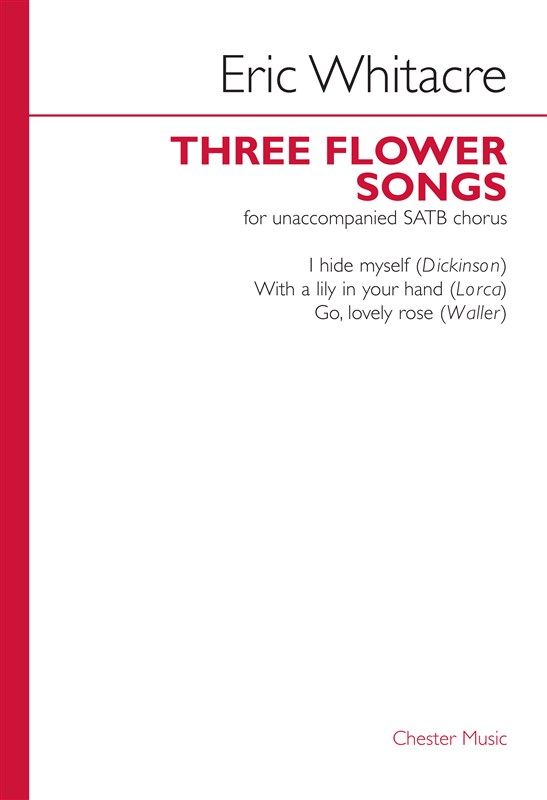
Eric Whitacre
Three Flower Songs
for unaccompanied SATB chorus
- Besetzung Gemischter Chor (SATB)
- Komponist Eric Whitacre
-
Schwierigkeit
- Ausgabe Noten
- Verlag Chester Music
- Bestell-Nr. CH75427
 auf Lager
Lieferzeit 1-3 Arbeitstage
inkl. MwSt.,
zzgl. Versand
Nicht in allen Ländern verfügbar. Mehr erfahren

Beschreibung:
Written early in Whitacre's career whilst at the University of Nevada in Las Vegas. Arranged for SATB choir, includes a Piano line for rehearsal purposes.
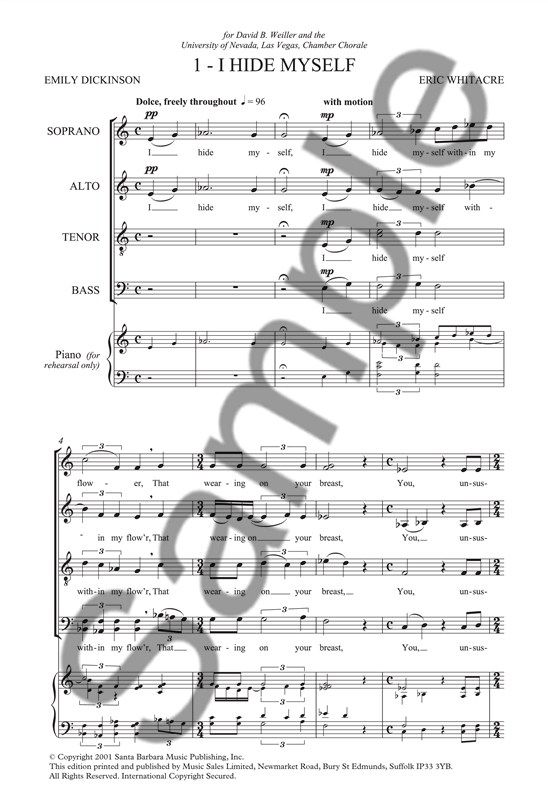
I Hide Myself
Just a simple song, really. All of the musical suggestions come from a careful study of the poem, a quiet, passionate soul occasionally speaking a little bolder than the age will allow. She loves almost to the point of distraction, and this mood must prevail in the performance: shy and sullen, her passion surging to the surface only to sink back into the silence that is herself.
Go, Lovely Rose
The piece is structured around the cyclical life of a rose, and is connection throughout by the opening 'rose motif', a seed that begins on the tonic and grows in all directions before it blossoms, dies and grows again. Each season is represented: spring begins the piece, summer appears at bar 13, autumn at bar 26, winter at bar 39 with spring returning at bar 49. The form is based on the Fibonacci sequence (the pattern found in plant and animal cell divisions) - its fifty five bars are a perfect Fibonacci number. The Golden Mean appears at bar 34 as all parts are reunited to complete the flower before its final blossom and inevitable cycle of death and rebirth.
Each performance should be approached with a chil-like innocence and naivety that allows us to marvel at the return of the rose each spring. The szforzandos throughout must be light and gentle.
With A Lily In Your Hand
Water and Fire. If the performance of this piece connects these contrasting elemental ideas, its success is guaranteed. Water: At bar 30, this ostinato should be fluid and gentle, only interrupted at bar 32 as the butterflies momentarily spring out of the texture; bars 35-38 the water should slowly transform back to fire. Bar 44 should be tiny bell-tones motivating the next nine bars, another patient, sensuous transformation back to fire. Fire: Everything else.
I Hide Myself
Just a simple song, really. All of the musical suggestions come from a careful study of the poem, a quiet, passionate soul occasionally speaking a little bolder than the age will allow. She loves almost to the point of distraction, and this mood must prevail in the performance: shy and sullen, her passion surging to the surface only to sink back into the silence that is herself.
Go, Lovely Rose
The piece is structured around the cyclical life of a rose, and is connection throughout by the opening 'rose motif', a seed that begins on the tonic and grows in all directions before it blossoms, dies and grows again. Each season is represented: spring begins the piece, summer appears at bar 13, autumn at bar 26, winter at bar 39 with spring returning at bar 49. The form is based on the Fibonacci sequence (the pattern found in plant and animal cell divisions) - its fifty five bars are a perfect Fibonacci number. The Golden Mean appears at bar 34 as all parts are reunited to complete the flower before its final blossom and inevitable cycle of death and rebirth.
Each performance should be approached with a chil-like innocence and naivety that allows us to marvel at the return of the rose each spring. The szforzandos throughout must be light and gentle.
With A Lily In Your Hand
Water and Fire. If the performance of this piece connects these contrasting elemental ideas, its success is guaranteed. Water: At bar 30, this ostinato should be fluid and gentle, only interrupted at bar 32 as the butterflies momentarily spring out of the texture; bars 35-38 the water should slowly transform back to fire. Bar 44 should be tiny bell-tones motivating the next nine bars, another patient, sensuous transformation back to fire. Fire: Everything else.
-
Go, Lovely Rose
-
I Hide Myself
-
With A Lily In Your Hand
Kunden bewerteten diesen Artikel:
Herstellerinformationen:
Hal Leonard Europe B. V.
Businesspark Friesland-West 15
8447
SL Heerenveen
Niederlande
Andere Kunden kauften auch:

Willy Burkhard
- Gemischter Chor (SATB)
- Chorpartitur
-
Lieferzeit 2-4 Arbeitstage
- Auch als Download verfügbar!
- Gemischter Chor (SATB)
- Chorpartitur
-
auf Lager
Lieferzeit 1-3 Arbeitstage

- Gemischter Chor (AATBarBarB)
- Chorpartitur
-
Lieferzeit 1-2 Wochen
Eric Whitacre
- Gemischter Chor (SATB) und Klavier
- Klavierpartitur
-
Lieferzeit 3-6 Arbeitstage
- Auch als Download verfügbar!

Depeche Mode
- Gemischter Chor (SATB)
- Noten
- Eric Whitacre
-
auf Lager
Lieferzeit 1-3 Arbeitstage - Auch als Download verfügbar!
Franz Schubert
- Gemischter Chor (SATB)
- Chorpartitur
- Carlo Marenco
-
auf Lager
Lieferzeit 1-3 Arbeitstage

Edward Elgar
- Gemischter Chor (SATB)
- Noten
-
auf Lager
Lieferzeit 1-3 Arbeitstage
- Gemischter Chor (SATB) und Klavier
- Klavierpartitur
-
Lieferzeit 2-4 Wochen
- Auch als Download verfügbar!
Felix Mendelssohn Bartholdy
- Gemischter Chor (SATB)
- Partitur
-
Lieferzeit 2-5 Arbeitstage
- Auch als Download verfügbar!
Ola Gjeilo
- Gemischter Chor (SSAATTBB)
- Chorpartitur
-
auf Lager
Lieferzeit 1-3 Arbeitstage


Morten Lauridsen
- Gemischter Chor (SATB)
- Noten
-
auf Lager
Lieferzeit 1-3 Arbeitstage