
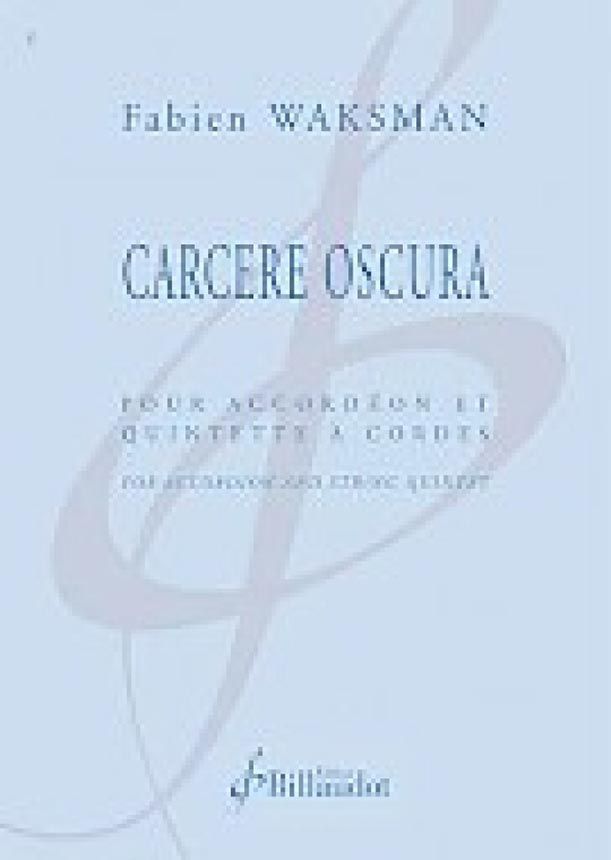
Fabien Waksman
Carcere Oscura
for Accordion and String Quintet
PDF
ansehen
Fabien Waksman
Carcere Oscura
for Accordion and String Quintet
- Besetzung Akkordeon, 2 Violinen, Viola, Cello und Kontrabass
- Komponist Fabien Waksman
- Ausgabe Partitur und Stimmen
- Verlag Gerard Billaudot
- Bestell-Nr. BILL10373
 Lieferzeit 4-8 Arbeitstage
inkl. MwSt.,
zzgl. Versand
Nicht in allen Ländern verfügbar. Mehr erfahren

Beschreibung:
What is it like for a composer to experience hearing loss?
Such was the question I tried to answer by composing this sextet in homage to Beethoven.
My starting point was a vision of Beethoven prisoner of his own body - an infinite prison, bath immense and oppressive. This inner world, which I imagined to be the mind of the composer without any auditory contact with the outer world, reminded me of Piranesi 's etchings. Carcere Oscura (1743) serves as a prelude to the Carceri d'Invenzione ('Imaginary Prisons') series, the artist 's masterpiece. The monumental character of Piranesi 's prison environment gives it a fan tas tic dimension. Yet for ail its immensity, it is an eternally confined, inhuman and therefore horrifying space. In the words of Marguerite Yourcenar, Piranesi's Carceri evoke "an artificial world that is nevertheless real in a sinister way, claustrophobie yet megalomaniacal, (and) brings to mind the world in which modem humanity seems to lock itselfup more and more each day."
The famous opening motif of Beethoven 's Fifth Symphony runs throughout the piece - most often at a frantic pace, as if desperately running through an ever-changing labyrinth, looking for a way out, for salace, for a gleam of light. Although the setting may vary dramatically, the sense of urgency is rare/y absent from the musical discourse in which, litt le by litt le, the accordion manages to gain independence from the dense, compact texture of the string ensemble.
With the emergence of a new cell from the second theme of the Fifth Symphony, calm settles in progressive/y. Panic subsides, the music becomes more jluctuating and meditative: it is lime for Beethoven to turn inward and find other strategies to cape with hearing loss. Then ail of a sudden, the frenetic pulse is omnipresent again, as if Beethoven had become aware of his ability to transcend himself and could not wait to get back to work. At this point, rage is no longer synonymous with despair but rather with eagerness. Carried by the obsessive hammering of the Fifth Symphony motif, the accordion seems to be dashing toward the way out of the labyrinth, like Beethoven rushing to work on his future masterpieces. Freeing himself from his inner prison, the composer will forever remain an example of the human ability to overcome the trials of life.
Such was the question I tried to answer by composing this sextet in homage to Beethoven.
My starting point was a vision of Beethoven prisoner of his own body - an infinite prison, bath immense and oppressive. This inner world, which I imagined to be the mind of the composer without any auditory contact with the outer world, reminded me of Piranesi 's etchings. Carcere Oscura (1743) serves as a prelude to the Carceri d'Invenzione ('Imaginary Prisons') series, the artist 's masterpiece. The monumental character of Piranesi 's prison environment gives it a fan tas tic dimension. Yet for ail its immensity, it is an eternally confined, inhuman and therefore horrifying space. In the words of Marguerite Yourcenar, Piranesi's Carceri evoke "an artificial world that is nevertheless real in a sinister way, claustrophobie yet megalomaniacal, (and) brings to mind the world in which modem humanity seems to lock itselfup more and more each day."
The famous opening motif of Beethoven 's Fifth Symphony runs throughout the piece - most often at a frantic pace, as if desperately running through an ever-changing labyrinth, looking for a way out, for salace, for a gleam of light. Although the setting may vary dramatically, the sense of urgency is rare/y absent from the musical discourse in which, litt le by litt le, the accordion manages to gain independence from the dense, compact texture of the string ensemble.
With the emergence of a new cell from the second theme of the Fifth Symphony, calm settles in progressive/y. Panic subsides, the music becomes more jluctuating and meditative: it is lime for Beethoven to turn inward and find other strategies to cape with hearing loss. Then ail of a sudden, the frenetic pulse is omnipresent again, as if Beethoven had become aware of his ability to transcend himself and could not wait to get back to work. At this point, rage is no longer synonymous with despair but rather with eagerness. Carried by the obsessive hammering of the Fifth Symphony motif, the accordion seems to be dashing toward the way out of the labyrinth, like Beethoven rushing to work on his future masterpieces. Freeing himself from his inner prison, the composer will forever remain an example of the human ability to overcome the trials of life.
Kunden bewerteten diesen Artikel:
Herstellerinformationen:
Gérard Billaudot Éditeur, S.A.S.
14, rue de l’Échiquier
75010
Paris
Deutschland
Andere Kunden kauften auch:
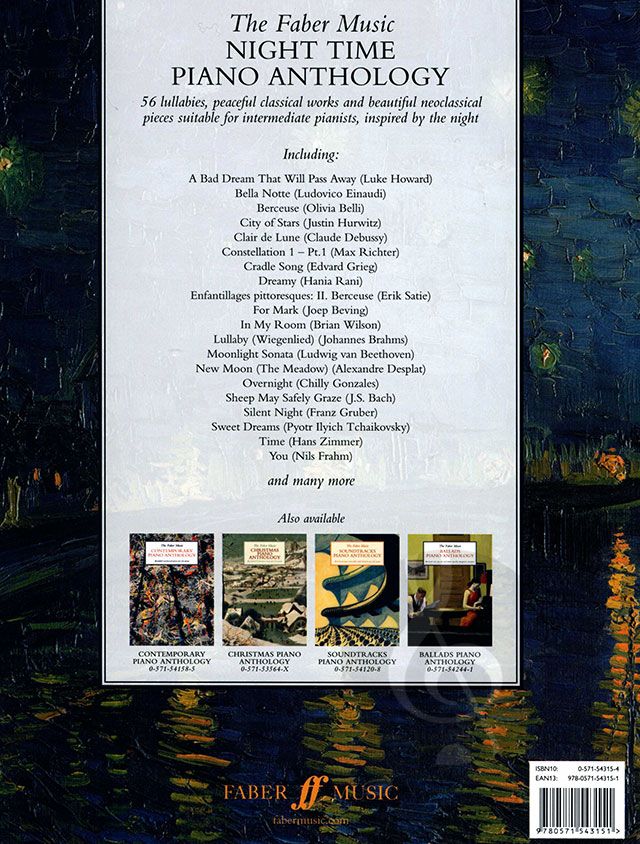
Eine Sammlung friedlicher Klaviersoli, inspiriert von der Nacht
- Klavier
- Noten
-
auf Lager
Lieferzeit 1-3 Arbeitstage