
Joan Tower
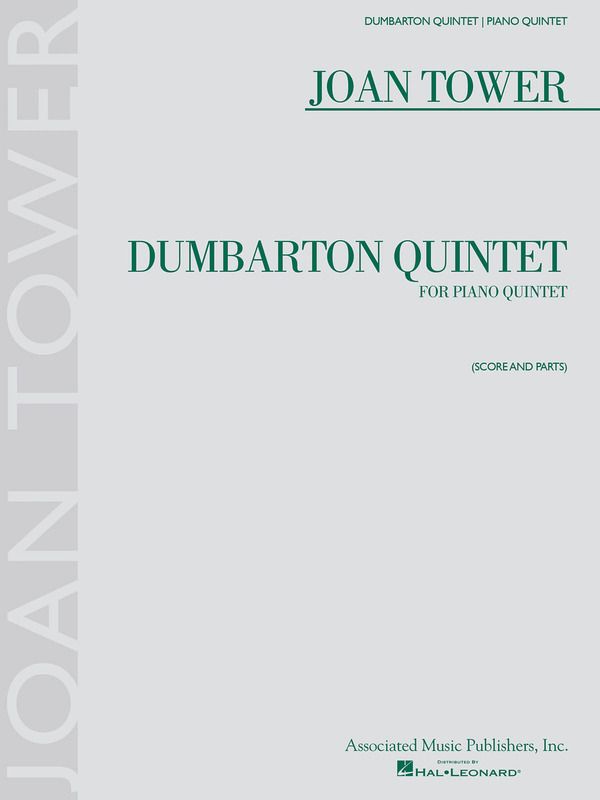
Dumbarton Quintet
Piano Quintet
Joan Tower
Dumbarton Quintet
Piano Quintet
- Besetzung Klavier und 4 Instrumente
- Komponist Joan Tower
- Serie Piano Ensemble
- Ausgabe Noten
- Verlag G. Schirmer
- Bestell-Nr. 50499247
 Lieferzeit 3-6 Arbeitstage
inkl. MwSt.,
zzgl. Versand
Nicht in allen Ländern verfügbar. Mehr erfahren

Beschreibung:
Joan Tower's Dumbarton Quintet (2008) for Piano Quintet. This work was premiered on 12 April 2008 at Dumbarton Oaks, Washington, DC, by the Enso String Quartet with Joan Tower on thePiano.
Following Stravinsky and Copland as the third commissioned composer by the Dumbarton Oaks Estate is of course quite daunting - particularly since these are two very strong composers that had an enormousinfluence on me. Their sense of musical continuity and profiling of ideas puts them in the category of musical geniuses. I have, in fact, dedicated two pieces to them: Petroushskates (to Stravinsky) and Fanfare for the UncommonWoman (to Copland). My musical debt to these two great composers is profound.
The Dumbarton Quintet is a Piano Quintet dedicated to Susan Feder, my longtime publisher at G. Schirmer and Associated MusicPublishers. (She is now withthe Mellon Foundation). It was commissioned by the Dumbarton Oaks Estate.
It is a 14-minute work in one movement that travels through several themes with different emotional contents. The first is a flowing linethat is cast in a narrow space of smaller intervals first soft, then loud but with a restrained kind of intensity that finally 'bursts out' into a more 'forward' and visceral type of intensity. Thisshifting between intensities, infact, is part of the 'dna' of the work and as the piece progresses; each side tends to take on more and more extremes of expression. At particular points, the 'softer' material becomes almostromantic, consonant and singing in itsexpression whereas the 'louder' passages become the opposite - manic and aggressively dissonant. - Joan Tower
Following Stravinsky and Copland as the third commissioned composer by the Dumbarton Oaks Estate is of course quite daunting - particularly since these are two very strong composers that had an enormousinfluence on me. Their sense of musical continuity and profiling of ideas puts them in the category of musical geniuses. I have, in fact, dedicated two pieces to them: Petroushskates (to Stravinsky) and Fanfare for the UncommonWoman (to Copland). My musical debt to these two great composers is profound.
The Dumbarton Quintet is a Piano Quintet dedicated to Susan Feder, my longtime publisher at G. Schirmer and Associated MusicPublishers. (She is now withthe Mellon Foundation). It was commissioned by the Dumbarton Oaks Estate.
It is a 14-minute work in one movement that travels through several themes with different emotional contents. The first is a flowing linethat is cast in a narrow space of smaller intervals first soft, then loud but with a restrained kind of intensity that finally 'bursts out' into a more 'forward' and visceral type of intensity. Thisshifting between intensities, infact, is part of the 'dna' of the work and as the piece progresses; each side tends to take on more and more extremes of expression. At particular points, the 'softer' material becomes almostromantic, consonant and singing in itsexpression whereas the 'louder' passages become the opposite - manic and aggressively dissonant. - Joan Tower