
György Kurtág
Einige Sätze aus den Sudelbüchern Georg Christoph Lichtenbergs
für Sopran und Kontrabass Op. 37a (1996/1999)
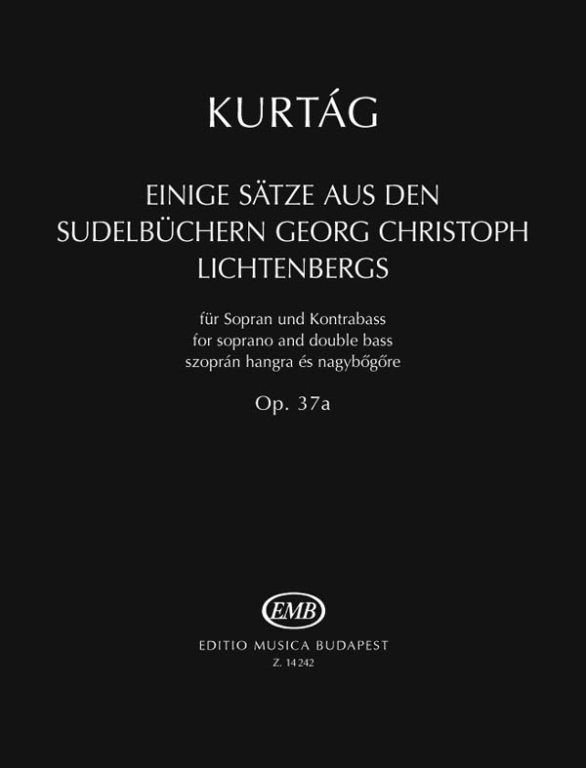
György Kurtág
Einige Sätze aus den Sudelbüchern Georg Christoph Lichtenbergs
für Sopran und Kontrabass Op. 37a (1996/1999)
- Besetzung Gesang (hoch) und Kontrabass
- Komponist György Kurtág
- Ausgabe Noten
- Verlag Editio Musica Budapest
- Bestell-Nr. EMB14242
Beschreibung:
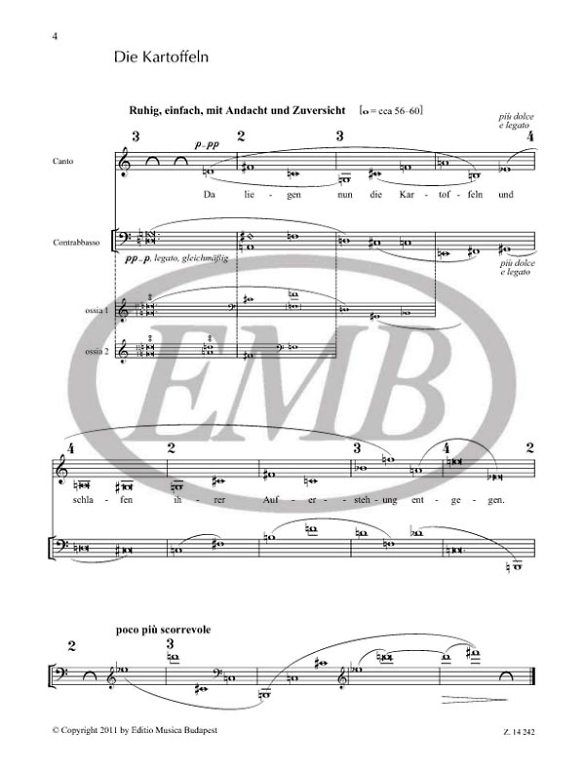
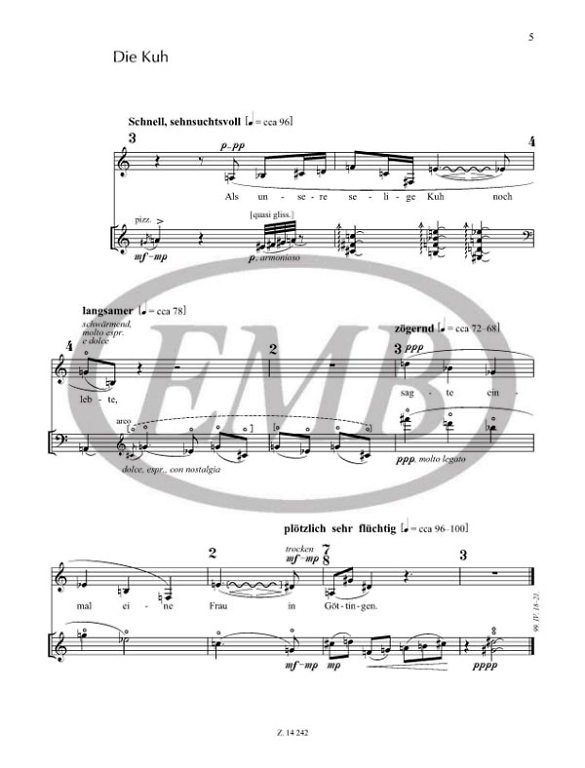
The polymath, naturalist and aesthetician Georg Christoph Lichtenberg (1742-1799) is an interesting figure of 18th-century German cultural history. Yet his most important work, his collection of aphorisms, only appeared posthumously. It embraces almost all the themes that concerned the thinkers of the era, often with a satirical tone. Kurtág selected texts from these volumes for his work, which in its original version (op. 37, 1996) was indeed a musical aphorism collection freely assembled by the performer - this version was withdrawn. However, the final form, composed in 1999, cannot be disjoined. It is a unified composition, although the material for the vocal scoreremained almost unchanged. Some pieces are purely aphoristic snapshots, yet by means of virtuoso double bass accompaniment, notwithstanding their brevity, are movements of great format. Thus the work can be placed beside Kurtág's major vocal cycles: it is akin to his Kafka Fragments, op. 24 and Attila József Fragments, op. 20 series, but is perhaps closest to Eszká-emlékzaj (Remembrance Noise), op. 12 duo for soprano and violin. Despite the short movements, the form is not fragmentary: the building blocks of the individual pieces of the closed unity within the cycle, even if in character they are different, in this respect echo the shaping principles of the early instrumental pieces (op. 1-5) in Kurtág's oeuvre.
Kunden bewerteten diesen Artikel:
Herstellerinformationen:
Hal Leonard Europe B. V.
Businesspark Friesland-West 15
8447
SL Heerenveen
Niederlande
Andere Kunden kauften auch:

- Gesang (hoch) und Klavier
- Noten
-
 Lieferzeit 3-6 Arbeitstage

- Gesang (hoch) und Klavier
- Noten
-
Lieferzeit 4-8 Arbeitstage
- Gesang (tief) und Klavier
- Noten
-
Lieferzeit 2-4 Wochen

György Kurtág
- Gesang und Klavier
- Noten
-
auf Lager
Lieferzeit 1-3 Arbeitstage

- Gesang (hoch) und Klavier
- Noten
-
Lieferzeit 4-8 Arbeitstage

- Gesang (tief) und Klavier
- Partitur und Stimmen Download
-
sofort verfügbar
Download sofort nach Bestellung
Georges Aperghis
- Gesang
- Noten
-
Lieferzeit 3-6 Arbeitstage

- Gesang
- Partitur
-
Lieferzeit 2-4 Wochen

- Gesang
- Noten
-
Lieferzeit 3-6 Arbeitstage
- Gesang
- Noten
-
Lieferzeit 3-6 Arbeitstage
Vinko Globokar
- Gesang und Klavier
- Noten
-
Lieferzeit 2-4 Wochen

- Gesang
- Noten
-
Lieferzeit 2-4 Wochen
- Gesang (mittel)
- Noten
-
auf Lager
Lieferzeit 1-3 Arbeitstage

- Gesang (hoch)
- Noten
-
Lieferzeit 3-6 Arbeitstage

- Gesang (tief)
- Singpartitur
-
auf Lager
Lieferzeit 1-3 Arbeitstage