
Bruno Mantovani
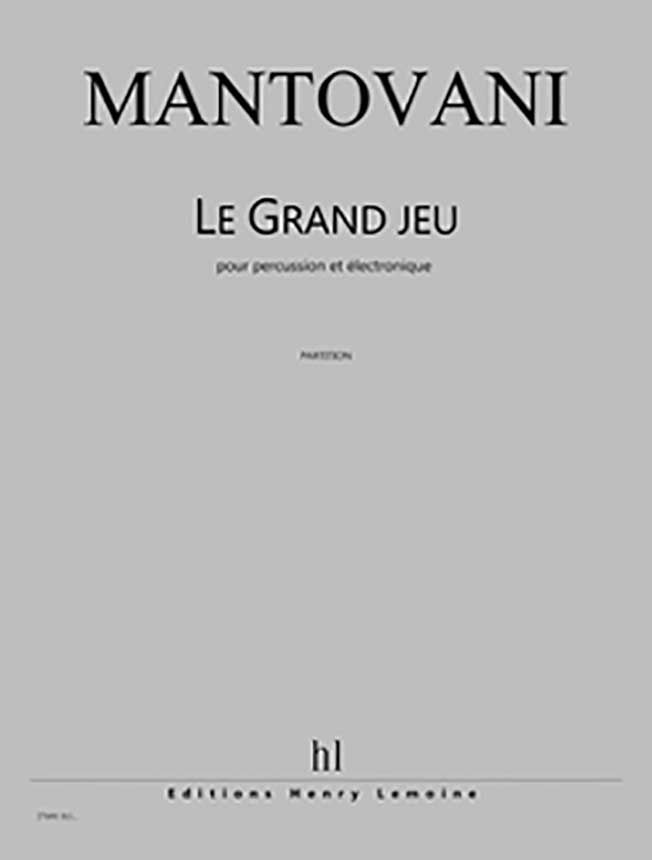
Le grand jeu
Bruno Mantovani
Le grand jeu
- Besetzung Percussion und Elektronik
- Komponist Bruno Mantovani
- Ausgabe Partitur
- Verlag Editions Henry Lemoine
- Bestell-Nr. LEMO27491
 Lieferzeit 4-8 Arbeitstage
inkl. MwSt.,
zzgl. Versand
Nicht in allen Ländern verfügbar. Mehr erfahren

Beschreibung:
Quite frequently I feel the need to write a work for a solo instrument. Generally this happens after I have composed a work for a large group, in contrast to which a solo piece demands more immediate inspiration, more spontaneous expression. So this allows me to produce a more balanced output between the 'polyphonic' works, which need a deep internal aural effort, and the 'monodic' music. For me the latter is something of an enjoyable pastime, because the musical idea is presented in a relatively synthetic and condensed state. A solo piece lends itself to experimentation, both on the instrument for which it is written of course, but also on the language itself. In the various works which feature in these two concerts (at Ircam and Edenkoben), there is a permanent reference to improvisation, both in the 'natural' and virtuoso playing (Bug, for clarinet, Moi, jeu, for marimba), and in the use of melodic or rhythmic formulas taken from the popular repertoire of oral tradition (such as the jazz elements in Jazz connotation for piano, latin American music and funk in Le Grand jeu for percussion and electronics). In that composition allows you to keep reins on the formal organisation, and thus to make the most of the unpredictable, it goes one further than the simple transcription of an imaginary improvisation. And a solo instrument requires its limits to be defined more than any group of instruments. If the structural and dramatic framework is consistent and well defined, then the most eccentric ideas can be incorporated without jarring on the listener. Without a polyphonic basis, the thematic material is given life by the formal articulation. For the most part, these works owe their existence to a meeting with a performer, such as Jean Geoffroy, Jay Gottlieb or Philippe Berrod, and when I am writing, I have a constant vision of the musician on stage. The idea I have of the future interpreter of the work has therefore a radical influence on my language, my poetic thoughts. This constant coming and going between my 'abstract' imagination and the vision that I conjure up of the instrumentalist giving the first performance is, for me, a formidable stimulus.Bruno Mantovani
Kunden bewerteten diesen Artikel:
Herstellerinformationen:
Henry Lemoine & Cie
27, Boulevard Beaumarchais
75004
Paris
Deutschland
Andere Kunden kauften auch:
Bruno Mantovani
- 3 Ensembles und Elektronik
- Partitur
-
Lieferzeit 4-8 Arbeitstage
Bruno Mantovani
- Percussion und Ensemble
- Noten
-
Lieferzeit 4-8 Arbeitstage

- Horn, Percussion, Glockenspiel, Klavier und Orchester
- Partitur
-
Lieferzeit 3-6 Arbeitstage

- Klavier und Orchester
- Partitur
-
Lieferzeit 2-4 Wochen
Philippe Hurel
- Percussion und Ensemble
- Partitur
-
Lieferzeit 4-8 Arbeitstage
- Gesang (tief) und 6 Instrumente
- Studienpartitur
-
auf Lager
Lieferzeit 1-3 Arbeitstage