
Peter Lawson
Song of The Coralroot Orchid
Demo
anhören
PDF
ansehen
Peter Lawson
Song of The Coralroot Orchid
- Besetzung Gesang und Klavier
- Komponist Peter Lawson
- Ausgabe Noten
- Verlag Goodmusic Publishing
- Bestell-Nr. GM087
 Lieferzeit 2-4 Wochen

Beschreibung:
The Song of the Coralroot Orchid, written in 1988 for Frances Ann Brooks for a concert in Putney - and revised in 2012 - was the fifteenth to be written in a projected series of musical portraits of the 48 wild orchids of Britain and Ireland for various solo, chamber and orchestral forces.
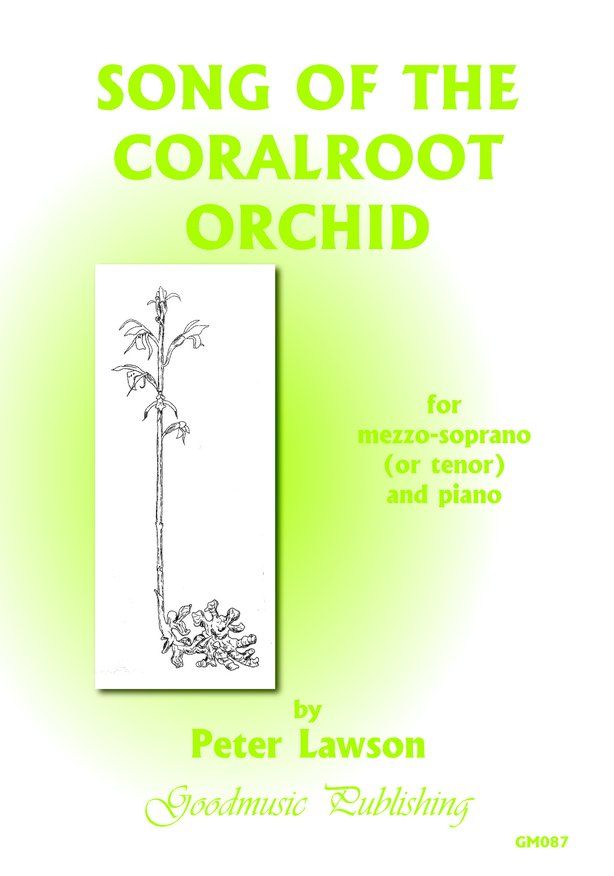
The Coralroot Orchid (Corallorhiza trifida) is difficult to spot as it is small - often tiny - and has a greenish-yellow appearance which tends to camouflage it against a background of pine needles and sphagnum moss. It does not have any leaves and although there is some chlorophyll in the stem, it is entirely dependent on a saphrophytic relationship with a mycorrhizal fungus, which its branched, coral-like 'roots' foster. It has a distinct Northerly distribution and in Britain it is mainly restricted to ancient Scottish pinewoods, heaths and dune slacks where it is distinctly rare. The flowers vary from a pinkish-cream to a greenish white and are often flecked with reddish-purple. The side petals resemble a bird in flight.
The music - for wordless mezzo-soprano (or tenor) and piano - opens with a 'misterioso' passage intended to evoke the habitat and the plant's mainly subterranean existence. There follows a faster section depicting the orchid's outward appearance and using a harmonic 'colour-coding' technique. Finally, we hear, fancifully, the 'song' of the orchid itself, - its 'inside story', as it were, reflecting the majesty and beauty of its surroundings. As the music finally winds down, the orchid appears to die, but remains alive underground and will perhaps pop up again next year. Peter Lawson
Duration 8 minutes
The Coralroot Orchid (Corallorhiza trifida) is difficult to spot as it is small - often tiny - and has a greenish-yellow appearance which tends to camouflage it against a background of pine needles and sphagnum moss. It does not have any leaves and although there is some chlorophyll in the stem, it is entirely dependent on a saphrophytic relationship with a mycorrhizal fungus, which its branched, coral-like 'roots' foster. It has a distinct Northerly distribution and in Britain it is mainly restricted to ancient Scottish pinewoods, heaths and dune slacks where it is distinctly rare. The flowers vary from a pinkish-cream to a greenish white and are often flecked with reddish-purple. The side petals resemble a bird in flight.
The music - for wordless mezzo-soprano (or tenor) and piano - opens with a 'misterioso' passage intended to evoke the habitat and the plant's mainly subterranean existence. There follows a faster section depicting the orchid's outward appearance and using a harmonic 'colour-coding' technique. Finally, we hear, fancifully, the 'song' of the orchid itself, - its 'inside story', as it were, reflecting the majesty and beauty of its surroundings. As the music finally winds down, the orchid appears to die, but remains alive underground and will perhaps pop up again next year. Peter Lawson
Duration 8 minutes