
Roberto Fabbri
Le Scale per Chitarra con 80 basi armonizzate su CD
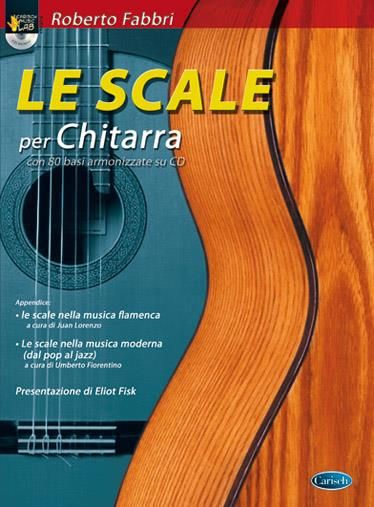
Roberto Fabbri
Le Scale per Chitarra con 80 basi armonizzate su CD
- Besetzung Gitarre
- Komponist Roberto Fabbri
- Serie Carisch Music Lab Italia
- Ausgabe Noten und CD
- Verlag Edition Carisch
- Bestell-Nr. CAR-ML2131
 Lieferzeit 3-6 Arbeitstage
inkl. MwSt.,
zzgl. Versand
Nicht in allen Ländern verfügbar. Mehr erfahren

Beschreibung:
The book is divided into chapters. In the first chapter you find first position major, and harmonic and melodic minor scales covering one octave. The second deals with first position major, and harmonic and melodic minor scales covering two octaves. In the third you find scales covering the whole fingerboard in other positions and fingerings (these are usually part of the first exam at the Conservatory). In the fourth chapter the symmetric scales (thirds, sixths, octaves, and tenths) complete the 'classical' part of the book.
The musical bases are for the first two chapters. You can play the bases as they are, you can change their rhythm (for example repeat each note four or two times), play the scale using third intervals (for example C, E, D, F, E, G, F, A, G, B, A, C), or whatever you are inspired to do. Using the bases as a support enables you to play the countless variations a scale may have. These bases may also be used for the scales in chapter three and four.
'The worlds of classical, flamenco and jazz guitar have much to teach one another yet until now they have developed mostly in a fashion reminiscent of multiple schizophrenia. It is therefore an especial pleasure to see the three worlds so ably brought together in the present publication. An accompanying CD offers some typical harmonic underpinnings to the various scales presented here so that students may simultaneously develop their harmonic sense and digital facility without lapsing into that all too familiar kind of rote playing that results from the mere, tone deaf (!) physical repetition of mechanical formulas. ' -Eliot Fisk-
The musical bases are for the first two chapters. You can play the bases as they are, you can change their rhythm (for example repeat each note four or two times), play the scale using third intervals (for example C, E, D, F, E, G, F, A, G, B, A, C), or whatever you are inspired to do. Using the bases as a support enables you to play the countless variations a scale may have. These bases may also be used for the scales in chapter three and four.
'The worlds of classical, flamenco and jazz guitar have much to teach one another yet until now they have developed mostly in a fashion reminiscent of multiple schizophrenia. It is therefore an especial pleasure to see the three worlds so ably brought together in the present publication. An accompanying CD offers some typical harmonic underpinnings to the various scales presented here so that students may simultaneously develop their harmonic sense and digital facility without lapsing into that all too familiar kind of rote playing that results from the mere, tone deaf (!) physical repetition of mechanical formulas. ' -Eliot Fisk-