
Franz Schubert
Marches Militaires
for piano duet
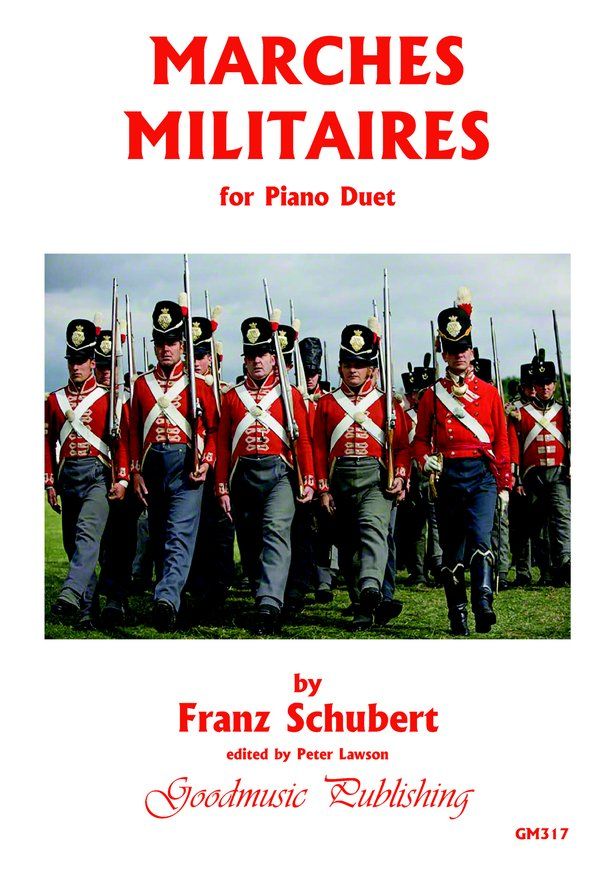
Demo
anhören
PDF
ansehen
Franz Schubert
Marches Militaires
for piano duet
- Besetzung Klavier zu 4 Händen
- Komponist Franz Schubert
- Ausgabe Noten
- Verlag Goodmusic Publishing
- Bestell-Nr. GM317
 Lieferzeit 2-4 Wochen

Beschreibung:
Edited by Peter Lawson, who has also done an orchestral arrangement of these three marches (Goodmusic GMCL213 and GMCL214), here is a new clear edition of these favourite pieces.
Schubert's 'Trois Marches Militaires' were written when the composer was in his early twenties, while teaching music to the daughters of Count Johann Karl Esterhazy at his summer home in Zseliz, then in Hungary. The French title may have been to deflect the performers from assuming that the marches were Austro-Hungarian in nature and, maybe, to appeal to a more international clientele when they were published in 1826. In this regard they do not stand alone, as the composer gave French titles to a number of piano pieces, such as the 'Moments Musicaux'. Sadly, Schubert only lived for another two years and never achieved recognition in France until after his death.
The three marches are in ternary form, with the march sections recapitulated after a central Trio. The first one, in D major, is by far the best known - even Stravinsky quotes it in his 'Circus Polka'. In fact, all three marches are equally tuneful and memorable. The second march is shorter and triumphal in nature. The third is longer and has an endearing 'swagger', with a spectacular appearance of Schubert's characteristic German 6th chord in the thirty-second bar. The central Trio sections, in particular, are full of Viennese finesse and will bring a smile of delight to the listener with their unexpected harmonic twists. They are charming, almost balletic in nature and it is no surprise that Isadora Duncan saw the choreographic potential of the first piece in 1909.
Above all, they are immense fun to play. 'Peter Lawson'
'Duration approx 17 minutes'
Schubert's 'Trois Marches Militaires' were written when the composer was in his early twenties, while teaching music to the daughters of Count Johann Karl Esterhazy at his summer home in Zseliz, then in Hungary. The French title may have been to deflect the performers from assuming that the marches were Austro-Hungarian in nature and, maybe, to appeal to a more international clientele when they were published in 1826. In this regard they do not stand alone, as the composer gave French titles to a number of piano pieces, such as the 'Moments Musicaux'. Sadly, Schubert only lived for another two years and never achieved recognition in France until after his death.
The three marches are in ternary form, with the march sections recapitulated after a central Trio. The first one, in D major, is by far the best known - even Stravinsky quotes it in his 'Circus Polka'. In fact, all three marches are equally tuneful and memorable. The second march is shorter and triumphal in nature. The third is longer and has an endearing 'swagger', with a spectacular appearance of Schubert's characteristic German 6th chord in the thirty-second bar. The central Trio sections, in particular, are full of Viennese finesse and will bring a smile of delight to the listener with their unexpected harmonic twists. They are charming, almost balletic in nature and it is no surprise that Isadora Duncan saw the choreographic potential of the first piece in 1909.
Above all, they are immense fun to play. 'Peter Lawson'
'Duration approx 17 minutes'