
Gustav Holst
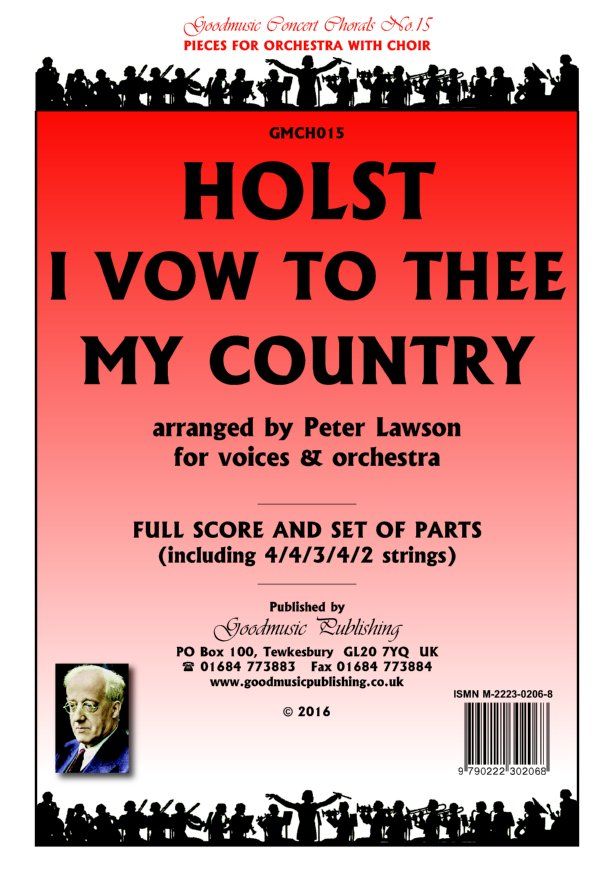
I Vow to Thee My Country
Demo
anhören
PDF
ansehen
Gustav Holst
I Vow to Thee My Country
- Besetzung Gesang und Orchester
- Komponist Gustav Holst
- Ausgabe Partitur und Stimmen
- Verlag Goodmusic Publishing
- Bestell-Nr. GMCH015
 Lieferzeit 2-4 Wochen

Beschreibung:
Orchestration: 2 Flutes (2nd db Piccolo), 2 Oboes, 2 Clarinets in Bb, 2 Bassoons, 4 Horns in F, 2 Trumpets in Bb, 3 Trombones, Tuba,
Timpani, Percussion (2 players: Cymbals, Tubular Bells, Bass Drum), Harp (or Keyboard)
Strings (Violin 1, Violin 2, Viola, Cello, Bass)
Unison Voices
The origin of the text is a poem by diplomat Sir Cecil Spring-Rice, which he wrote in 1908 or 1912, entitled 'Urbs Dei' ('The City of God'). The poem described how a Christian owes his loyalties to both his homeland and the heavenly kingdom. In 1912 Spring-Rice was Ambassador to the United States of America, where he influenced the administration of Woodrow Wilson to abandon neutrality and join Britain in the war against Germany. After the United States entered the war, he was recalled to Britain. Shortly before his departure from the US in January 1918, he re-wrote and renamed 'Urbs Dei', significantly altering the first verse to concentrate on the themes of love and sacrifice rather than 'the noise of battle' and 'the thunder of her guns', creating a more sombre tone in view of the dreadful loss of life suffered in the Great War. The poem circulated privately for a few years, until it was set to music by Holst, to a tune he adapted from his Jupiter (from 'The Planets') to fit the words of the poem. It was performed as a unison song with orchestra in the early 1920s.
A PACK comprises an A4 sized full score plus a complete set of parts including strings 4/4/3/4/2 and one copy of the 'voices' part.
'Duration 3 minutes'
Timpani, Percussion (2 players: Cymbals, Tubular Bells, Bass Drum), Harp (or Keyboard)
Strings (Violin 1, Violin 2, Viola, Cello, Bass)
Unison Voices
The origin of the text is a poem by diplomat Sir Cecil Spring-Rice, which he wrote in 1908 or 1912, entitled 'Urbs Dei' ('The City of God'). The poem described how a Christian owes his loyalties to both his homeland and the heavenly kingdom. In 1912 Spring-Rice was Ambassador to the United States of America, where he influenced the administration of Woodrow Wilson to abandon neutrality and join Britain in the war against Germany. After the United States entered the war, he was recalled to Britain. Shortly before his departure from the US in January 1918, he re-wrote and renamed 'Urbs Dei', significantly altering the first verse to concentrate on the themes of love and sacrifice rather than 'the noise of battle' and 'the thunder of her guns', creating a more sombre tone in view of the dreadful loss of life suffered in the Great War. The poem circulated privately for a few years, until it was set to music by Holst, to a tune he adapted from his Jupiter (from 'The Planets') to fit the words of the poem. It was performed as a unison song with orchestra in the early 1920s.
A PACK comprises an A4 sized full score plus a complete set of parts including strings 4/4/3/4/2 and one copy of the 'voices' part.
'Duration 3 minutes'