
Michael Jarrell
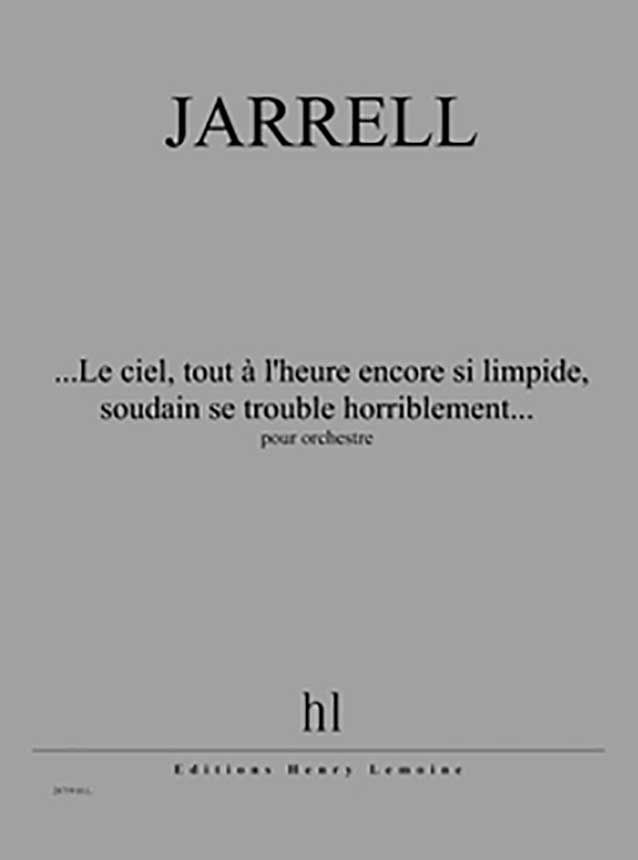
...Le ciel, tout à l'heure encore si limpide
soudain se trouble horriblement...
PDF
ansehen
Michael Jarrell
...Le ciel, tout à l'heure encore si limpide
soudain se trouble horriblement...
- Besetzung Orchester
- Komponist Michael Jarrell
- Ausgabe Partitur
- Verlag Editions Henry Lemoine
- Bestell-Nr. LEMO28759
 Lieferzeit 4-8 Arbeitstage
inkl. MwSt.,
zzgl. Versand
Nicht in allen Ländern verfügbar. Mehr erfahren

Beschreibung:
...Le ciel, tout à l'heure encore si limpide, soudain se trouble horriblement...(...The sky, recently so clear, suddenly becomes horribly murky...) On the nature... of musicality Michael Jarrell, born in 1958, is one of the most visible composers of his generation. In his thoroughly personal approach, unaligned with any other movement and relentlessly pursuing an inner quest, he has implemented a synthesis from the legacy of post-war music, extracting various technical features and putting them at the service of true musical poetics. Actually, in contrast with his predecessors, he explores language less as such, making these new techniques the focus for a mutation of musical reflection, rather than trying to subjugate it to expression. He is also wary of excessive conceptualization, and of the utopia that a work could convey, preferring to highlight the virtues of a craft that he teaches in Vienna and Geneva, as well as numerous European seminars. His works, readily distinguishable among the profuse output of contemporary music, are all interrelated, not only by a certain form of sensitivity and their particular tone, but also by the recurrence of particular features that Jarrell reworks in different contexts. Thus, early on, he constituted a universe that he continues to reorganize, aiming less for the seeming originality of each piece than for a constant displacement of perspectives in which the same ideas can in themselves be discerned. 'Craft a hundred times over...' this is what could be his motto. We thus discover something familiar in each of his works that at the same time takes on a certain strangeness, a feeling that perhaps constitutes an essential element of his expressiveness. Jarrell's music contemplates territories of dream and unreality, searching for that moment of truth often set in the lowest and slowest sonorities, a place where time, agitated elsewhere, becomes immobilised. It is perhaps this that endows his music with a sort of tenderness inseparable from sonic beauty, even reaching a refined aestheticism, distant from intense research and authoritarian formulae. For him, even the most unusual instrumental techniques, or the electronic sounds that he often uses, are repatriated into a sensitive world derived from purity, where expressive qualities dominate. These do not necessarily refer back to the 'me' of the composer, which tends on the contrary to diminish, but rather to the real essence of musicality, to the phenomenon itself, emissary of a singular presence to the world.The same qualities found in his last work, ...Le ciel, tout à l'heure encore si limpide, soudain se trouble horriblement..., a commission from the Orchestre de la Suisse Romande. It employs a standard large symphony orchestra: 3 flutes (including alto and piccolo), 2 oboes and English horn, 2 clarinets and bass clarinet, 2 bassoons and contrabassoon, 4 horns, 3 trumpets, 3 trombones, tuba, harp, tympani, 4 percussionists (vibraphone, glockenspiel, tubular bells, cymbals, bongos, tam-tam, bass drum, temple blocks, low tom, spring coils, triangle, mark tree) and strings. Despite a title that could imply a programmatic leaning, the work belongs to the category of pure music. The orchestra is treated in a conventional manner, but with a virtuosic writing style and sonic refinement extremely demanding for performers. Through-composed, the work can be divided into four principal sections of unequal length, the first two being longer than the two that follow: the first consists of a continuum of rapid notes distributed between the strings and the woodwinds, while the trumpets, doubled by various instruments, let loose an incisive calling figure that lengthens progressively. The writing is highly virtuosic, figures in demisemiquavers move from one instrument or from one group to another. The rapid notes come to a halt the first time within oscillations played notably by the divided strings, then during repeated notes that move through the en
Kunden bewerteten diesen Artikel:
Herstellerinformationen:
Henry Lemoine & Cie
27, Boulevard Beaumarchais
75004
Paris
Deutschland
Andere Kunden kauften auch:
Matthias Pintscher
- Cello und Orchester
- Partitur
-
Lieferzeit 2-4 Arbeitstage
- Klarinette, Cello und Orchester
- Partitur
-
Lieferzeit 4-8 Arbeitstage
- Violine und Orchester
- Studienpartitur
-
Lieferzeit 2-4 Arbeitstage
Michael Jarrell
- Orchester
- Partitur
-
Lieferzeit 4-8 Arbeitstage
Michael Jarrell
- Oboe und Orchester
- Partitur
-
Lieferzeit 4-8 Arbeitstage