
Colin Matthews
Pluto - The Renewer
for large Orchestra (for Performance with Holst's "The Planets") - Score
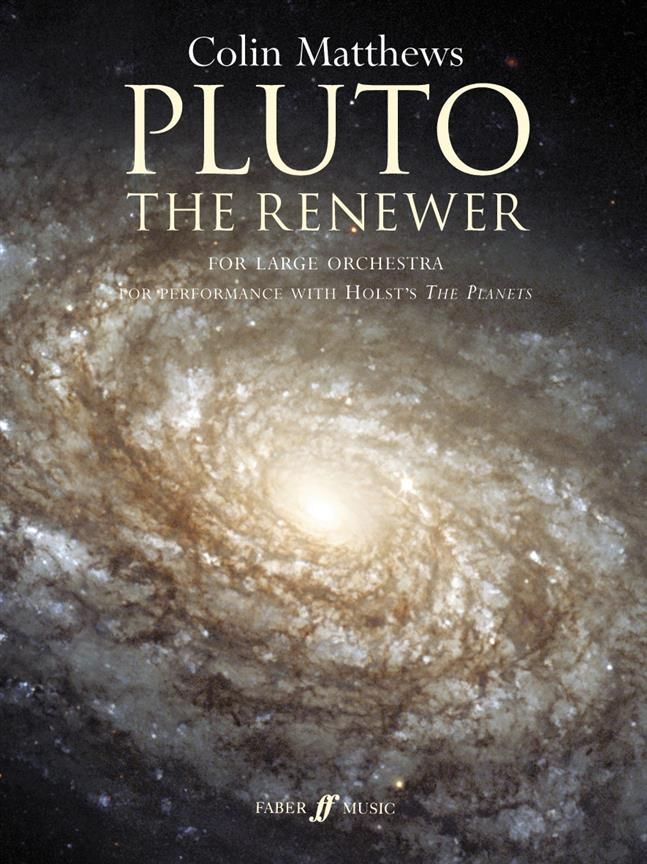
Colin Matthews
Pluto - The Renewer
for large Orchestra (for Performance with Holst's "The Planets") - Score
- Besetzung Orchester
- Komponist Colin Matthews
- Ausgabe Partitur
- Verlag Faber Music
- Bestell-Nr. 057152074X
 Lieferzeit 3-6 Arbeitstage
inkl. MwSt.,
zzgl. Versand
Nicht in allen Ländern verfügbar. Mehr erfahren

Beschreibung:
"Pluto is dedicated to the memory of Holst's daughter Imogen, with whom I worked for many years until her death in 1984, and who I suspect would have been both amused and dismayed by this venture."
Instrumentation: picc.2.afl.2.ca.bob.3.bcl.3.cbsn – 6.4.3.2 – 2 timp – perc(4): glsp/crot/bells/TD/BD/susp.cym/cyms/tam-t/tgl – 2 harp – cel – organ – strings – offstage female chorus in 7 parts(ad lib)
When Kent Nagano asked me to add Pluto to The Planets I had mixed feelings. To begin with, The Planets is a very satisfying whole, and one which makes perfect musical sense. Neptune ends the work in a way wholly appropriate for Holst - an enigmatic composer, always likely to avoid the grand gesture if he could do something unpredictable instead. How could I begin again, after the music has completely faded away as if into outer space? And, even though Pluto was discovered four years before Holst's death in 1934, I am certain that he never once thought to write an additional movement (he was in any case decidedly ambivalent about the work's huge popularity). In addition, the matter of Pluto's status as a planet has for some time been in doubt - it may well be reclassified (together with its tiny satellite Charon) as no more than one of the largest of the many Kuyper Belt objects beyond the orbit of Neptune. Another intriguing fact about Pluto us that its elliptical orbit means that for the past twenty years it has been nearer to us than Neptune.) Yet the challenge of trying to write a new movement for The Planets without attempting to impersonate Holst eventually proved irresistible. t quickly became clear that it would be pointless to write a movement that was even more remote than Neptune unless the whole orchestra were to join the chorus off-stage. Nor did I feel that I should rely on the astrological significance of Pluto, which is more than a little ambiguous (not that astrologers seem to have problems with a minute planet that they have only just become aware of). In any case I am a thoroughgoing sceptic as far as astrology is concerned - I suspect that Holst's interest too was pretty peripheral - and, apart from choosing the title 'Pluto, the Renewer', left that aspect to one side. The only possible way to carry on from where Neptune leaves off is not to make a break at all, and so Pluto begins before Neptune has quite faded. And it is very fast - faster even than Mercury: solar winds were my starting point. The movement soon took on an identity of its own, following a path which I seemed to be simply allowing to proceed as it would: in the process I came perhaps closer to Holst than I had expected, although at no point did I think to write pastiche. At the end the music disappears, almost as if Neptune had been quietly continuing in the background. Pluto is dedicated to the memory of Holst's daughter Imogen, with whom I worked for many years until her death in 1984, and who I suspect would have been both amused and dismayed by this venture.
Colin Matthews
Instrumentation: picc.2.afl.2.ca.bob.3.bcl.3.cbsn – 6.4.3.2 – 2 timp – perc(4): glsp/crot/bells/TD/BD/susp.cym/cyms/tam-t/tgl – 2 harp – cel – organ – strings – offstage female chorus in 7 parts(ad lib)
When Kent Nagano asked me to add Pluto to The Planets I had mixed feelings. To begin with, The Planets is a very satisfying whole, and one which makes perfect musical sense. Neptune ends the work in a way wholly appropriate for Holst - an enigmatic composer, always likely to avoid the grand gesture if he could do something unpredictable instead. How could I begin again, after the music has completely faded away as if into outer space? And, even though Pluto was discovered four years before Holst's death in 1934, I am certain that he never once thought to write an additional movement (he was in any case decidedly ambivalent about the work's huge popularity). In addition, the matter of Pluto's status as a planet has for some time been in doubt - it may well be reclassified (together with its tiny satellite Charon) as no more than one of the largest of the many Kuyper Belt objects beyond the orbit of Neptune. Another intriguing fact about Pluto us that its elliptical orbit means that for the past twenty years it has been nearer to us than Neptune.) Yet the challenge of trying to write a new movement for The Planets without attempting to impersonate Holst eventually proved irresistible. t quickly became clear that it would be pointless to write a movement that was even more remote than Neptune unless the whole orchestra were to join the chorus off-stage. Nor did I feel that I should rely on the astrological significance of Pluto, which is more than a little ambiguous (not that astrologers seem to have problems with a minute planet that they have only just become aware of). In any case I am a thoroughgoing sceptic as far as astrology is concerned - I suspect that Holst's interest too was pretty peripheral - and, apart from choosing the title 'Pluto, the Renewer', left that aspect to one side. The only possible way to carry on from where Neptune leaves off is not to make a break at all, and so Pluto begins before Neptune has quite faded. And it is very fast - faster even than Mercury: solar winds were my starting point. The movement soon took on an identity of its own, following a path which I seemed to be simply allowing to proceed as it would: in the process I came perhaps closer to Holst than I had expected, although at no point did I think to write pastiche. At the end the music disappears, almost as if Neptune had been quietly continuing in the background. Pluto is dedicated to the memory of Holst's daughter Imogen, with whom I worked for many years until her death in 1984, and who I suspect would have been both amused and dismayed by this venture.
Colin Matthews
Kunden bewerteten diesen Artikel:
Herstellerinformationen:
Faber Peters Music Distribution
Talstr. 10
04103
Leipzig
Deutschland
Andere Kunden kauften auch:
Joseph Haydn
- Orchester
- Partitur
- Howard Chandler Robbins Landon
-
Lieferzeit 2-4 Wochen

Johann Nepomuk Hummel
- Trompete und Orchester
- Partitur (Urtext)
-
Lieferzeit 2-5 Arbeitstage
- Frauenchor (12-stimmig) und Orchester
- Studienpartitur
-
auf Lager
Lieferzeit 1-3 Arbeitstage - Auch als Download verfügbar!
- Orchester
- Partitur (Urtext)
-
Lieferzeit 2-5 Arbeitstage
Wolfgang Amadeus Mozart
- Orchester
- Partitur (Urtext)
-
auf Lager
Lieferzeit 1-3 Arbeitstage - Auch als Download verfügbar!