
Charles Ives
Postlude in F

Charles Ives
Postlude in F
- Besetzung Orchester
- Komponist Charles Ives
- Serie Orchestra
-
Schwierigkeit
- Ausgabe Partitur und Stimmen
- Verlag G. Schirmer
- Bestell-Nr. 50481114
 Lieferzeit 3-6 Arbeitstage
inkl. MwSt.,
zzgl. Versand
Nicht in allen Ländern verfügbar. Mehr erfahren

Beschreibung:
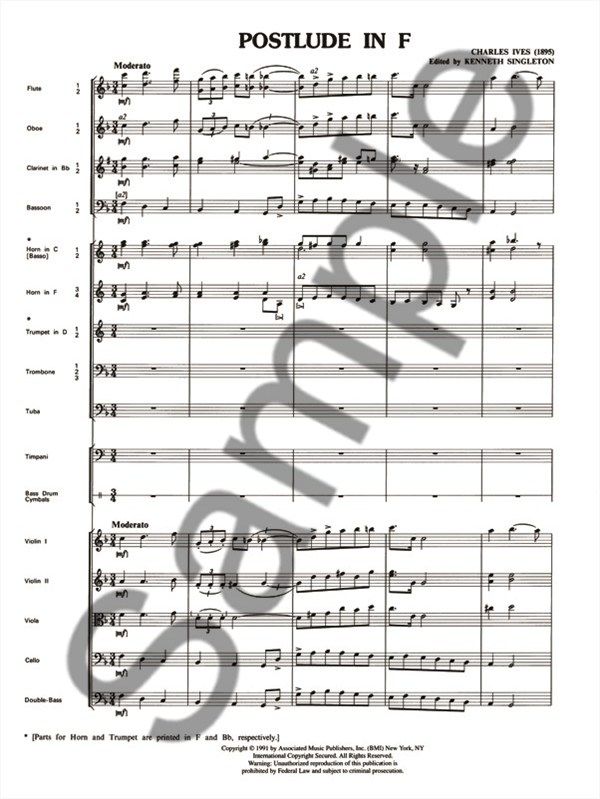
Charles Ives' Postlude In F for Orchestra. Score and parts.
The Postlude in F, composed in 1895, is Charles Ives' earliest known work for large Orchestra. It is based onanearlier Organ piece, which Ives performed at the Baptist Church in Danbury, Conneticut, on May 11, 1890 (at the age of fifteen; on the cover page of the full score Ives mistakenly gave 1892 for the year of theOrgancomposition). The version for Orchestra was probably produced as an orchestration assignment for a class of Horatio Parker, Ives' teacher at Yale College. Ives recalled that the 'New Haven Orchestra' - thatis, the New Haven Symphony Orchestra, organised by Parker in 1895- read through the work in 1896. The Postlude in F, which was also preperation for work on the First Symphony (its first movement also completedin1895), contains some suprisingly mature and beautiful writing, especially in the magical closing pages. - Kenneth D. Singleton.
The Postlude in F, composed in 1895, is Charles Ives' earliest known work for large Orchestra. It is based onanearlier Organ piece, which Ives performed at the Baptist Church in Danbury, Conneticut, on May 11, 1890 (at the age of fifteen; on the cover page of the full score Ives mistakenly gave 1892 for the year of theOrgancomposition). The version for Orchestra was probably produced as an orchestration assignment for a class of Horatio Parker, Ives' teacher at Yale College. Ives recalled that the 'New Haven Orchestra' - thatis, the New Haven Symphony Orchestra, organised by Parker in 1895- read through the work in 1896. The Postlude in F, which was also preperation for work on the First Symphony (its first movement also completedin1895), contains some suprisingly mature and beautiful writing, especially in the magical closing pages. - Kenneth D. Singleton.