
Edward Elgar
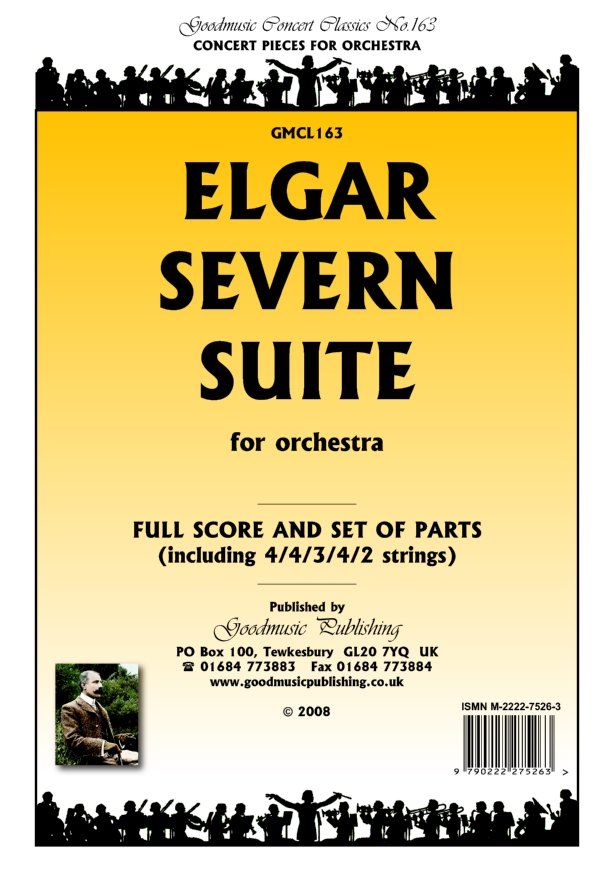
Severn Suite
for orchestra
Demo
anhören
PDF
ansehen
Edward Elgar
Severn Suite
for orchestra
- Besetzung Orchester
- Komponist Edward Elgar
- Ausgabe Partitur und Stimmen
- Verlag Goodmusic Publishing
- Bestell-Nr. GMCL163
 Lieferzeit 2-4 Wochen

Beschreibung:
Orchestration:
Piccolo, 2 Flutes, 2 Oboes, Cor Anglais, 2 Clarinets in Bb, Bass Clarinet, 2 Bassoons, Contra Bassoon
4 Horns in F, 3 Trumpets in Bb, 3 Trombones, Tuba, Timpani, Percussion (Side drum, Cymbals, Bass drums)
Strings (Violin 1, Violin 2, Viola, Cello, Bass)
Elgar's Severn Suite was originally written for brass band, and given its first performance in 1930. The arrangement for full symphony orchestra was made shortly afterwards, and Elgar himself conducted its first performance at a recording session for His Master's Voice in 1932. Whereas the brass-band version quickly became a popular classic, the orchestral version languished in relative obscurity. The Elgar recording did not sell well and was quickly deleted from the catalogues, and the orchestral full score was never published in Elgar's lifetime.
This was somewhat unjust, given that the music of the Severn Suite is of high quality, as the popularity of the brass-band version bears out. Elgar had effectively given up composition following his wife's death in 1920, and of the few works subsequently completed by him, the Severn Suite is the only one to show glimpses of his former mastery of large-scale symphonic composition.
The five linked movements are all based to some extent on the two opening themes. The pageantry of the Introduction is followed by an exciting Toccata. The courtly aspects of mediaeval life are displayed in the Minuet, and this is preceded by the tragic Fugue (this movement, originally written for piano in 1923, is considered by many to be a deeply felt lament for Elgar's departed wife). Finally the Coda returns to the music of the opening.
Duration 19 minutes
Piccolo, 2 Flutes, 2 Oboes, Cor Anglais, 2 Clarinets in Bb, Bass Clarinet, 2 Bassoons, Contra Bassoon
4 Horns in F, 3 Trumpets in Bb, 3 Trombones, Tuba, Timpani, Percussion (Side drum, Cymbals, Bass drums)
Strings (Violin 1, Violin 2, Viola, Cello, Bass)
Elgar's Severn Suite was originally written for brass band, and given its first performance in 1930. The arrangement for full symphony orchestra was made shortly afterwards, and Elgar himself conducted its first performance at a recording session for His Master's Voice in 1932. Whereas the brass-band version quickly became a popular classic, the orchestral version languished in relative obscurity. The Elgar recording did not sell well and was quickly deleted from the catalogues, and the orchestral full score was never published in Elgar's lifetime.
This was somewhat unjust, given that the music of the Severn Suite is of high quality, as the popularity of the brass-band version bears out. Elgar had effectively given up composition following his wife's death in 1920, and of the few works subsequently completed by him, the Severn Suite is the only one to show glimpses of his former mastery of large-scale symphonic composition.
The five linked movements are all based to some extent on the two opening themes. The pageantry of the Introduction is followed by an exciting Toccata. The courtly aspects of mediaeval life are displayed in the Minuet, and this is preceded by the tragic Fugue (this movement, originally written for piano in 1923, is considered by many to be a deeply felt lament for Elgar's departed wife). Finally the Coda returns to the music of the opening.
Duration 19 minutes