
Michael Jarrell
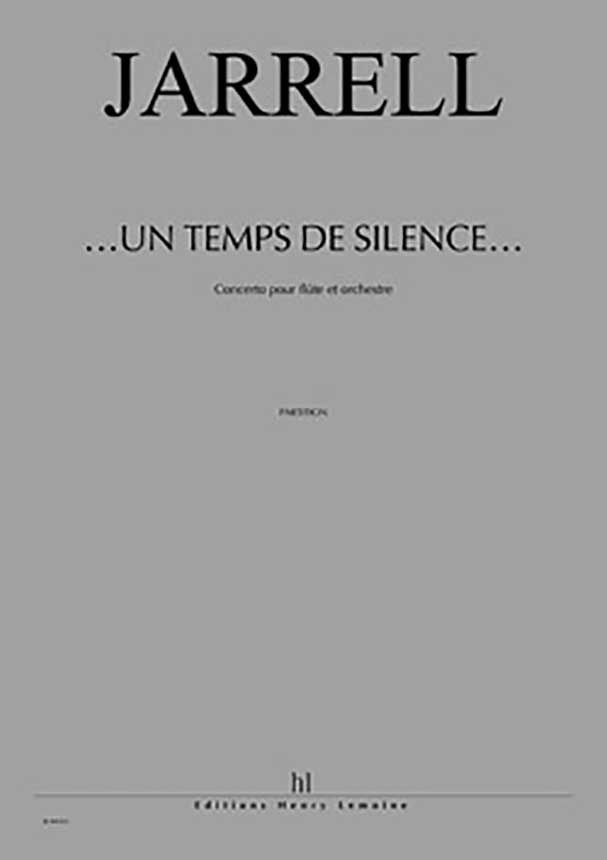
...Un temps de silence...
Concerto pour flûte
PDF
ansehen
Michael Jarrell
...Un temps de silence...
Concerto pour flûte
- Besetzung Querflöte und Orchester
- Komponist Michael Jarrell
- Ausgabe Partitur
- Verlag Editions Henry Lemoine
- Bestell-Nr. LEMO28494
 Lieferzeit 4-8 Arbeitstage
inkl. MwSt.,
zzgl. Versand
Nicht in allen Ländern verfügbar. Mehr erfahren

Beschreibung:
The Geneva-born composer Michael Jarrell writes music based on the idea of dialogue. Most of his recent works for large ensemble place one or more soloists in relation to a massed orchestral sound, either against it, echoing it or resonating with it. Example include ...prisme / incidences... for violin and orchestra (1998), Assonance IX for clarinet end orchestra (2000), the piano concerto Abschied (2001), Epigraphe for accordion and orchestra (2003) or even Sillages, for solo flute, oboe and clarinet, which was given its world premiere during the Orchestre de la Suisse Romande's 2005-06 season. His latest ...un temps de silence..., puts the spotlight on the solo flute.'It's not really a concerto as such, but it's more like one than other pieces,' the composer has teasingly confided. 'Certainly, there is none of traditional division of roles between the soloist and the accompaniment. The flute is constantly having to impose itself. The orchestra is not there to bring it out, but as its own autonomous role. In that sense, ...un temps de silence... is closer to my Piano Concerto than to ...prismes / incidence..., where everything came from the violin'.As the title of this new work suggests, the music is moving in the direction of evaporation. Jarrell's own comments back this up: 'I wanted to make it possible to hear different types of silence, and the only way you can perceive them is by varying the contexts. The sort of silence you have after a single chord is not the same as after a flurry of notes.' Several temporal ideas are pitted against one another. The first of these is very rhythmic, and emerges from the orchestra before being taken up by the flute. Another corresponds to 'moments that stand outside time, that slip towards silence'. Fiendishly difficult writing demands increasing virtuosity from the soloist.'Emmanuel Pahud came to see me, and we worked together on what it was possible to make the flute do', says the composer. 'The score was made to measure, taking account of Emmanuel's capabilities'. ...un temps de silence... opens with three marcato chords for strings, percussion, harp and piano - these can be clearly heard returning three times, but orchestrated differently. The chords also generate the 'phantom harmony' that supports the work as a whole. Gradually, the orchestra establishes a regular pulsation, which 'plunges the flute into a situation of stress', in the composer's words. It cling on, tries to catch up with the orchestra, pursuing it at full pelt. The intricacy of this passage, where the soloist and orchestra rapidly alternate or are superimposed, makes it fraught with difficulties. A huge tutti introduces the central section, where the soloist and orchestra move in symbiosis at a very slow tempo that gradually drifts towards a kind of enigmatic, 'out of time' section. Then there is silence. The final section sets off at a gallop, but this time it is the flute that dictates the rhythm to the orchestra, and it becomes the hub around which all the other instruments resolve. Finally, the orchestra takes the upper hand in this game of cat and mouse during an episode lasting about a minute, played at dizzying speed. Two of the three opening chord return, then dissolve in a slow passage dominated by percussion, particularly bongos. Jarrell then introduces a quotation from his own opera Galilée, premiered last season at the Grand Théâtre de Genève: accompanied by three Japanese rins and various instruments, a high woodblock plays a regular pulse, with commentaries from the flute. The harmony becomes fixed, and time stands still, like a freeze-frame. The music does not disappear in the silence. It become its negative, its shadow, its breath. Luca Sabbatini,translation: Kenneth Chalmers,extract from the recording 'Flute Concertos, Emmanuel Pahud'
Kunden bewerteten diesen Artikel:
Herstellerinformationen:
Henry Lemoine & Cie
27, Boulevard Beaumarchais
75004
Paris
Deutschland
Andere Kunden kauften auch:
Jörg Widmann
- Violine und Orchester
- Studienpartitur
-
auf Lager
Lieferzeit 1-3 Arbeitstage - Auch als Download verfügbar!
- Orchester
- Partitur
-
Lieferzeit 2-4 Wochen