
James MacMillan
Seven Last Words from the Cross
Kantate
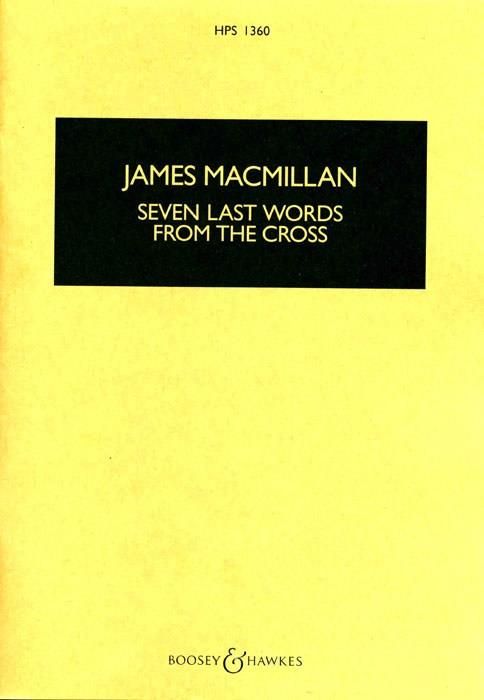
James MacMillan
Seven Last Words from the Cross
Kantate
- Besetzung Gemischter Chor (SATB) und Streichorchester
- Komponist James MacMillan
- Serie Hawkes Pocket Scores
- Ausgabe Studienpartitur
- Verlag Boosey & Hawkes
- Bestell-Nr. BH6501487
Beschreibung:
Gemischter Chor (SATB) und Streichorchester
Widely admired as one of MacMillan's finest achievements, his Seven Last Words promises an absorbing and moving experience in concert, for performers and audience alike. This cantata follows Christ's final utterances at the Crucifixion, meditating on each to form a dramatic and emotional sequence. Both the vocal and instrumental parts draw on characteristic models: Lutheran baroque techniques for the chorus, and the sophisticated British and Polish 20th century traditions of writing for the string orchestra.
The traditional text of the Seven Last Words from the Cross is based on a compilation from all four gospels to form a sequential presentation of the last seven sentences uttered by Christ (in English and Latin). The work was commissioned by BBC Television and broadcast in seven nightly episodes during Holy Week of 1994
This is rightly regarded as MacMillan's masterpiece. It is not easy - none of MacMillan's music really is - but what riches there are for those who scale these heights. MacMillan's conviction in this music, stemming from his deep faith, is passionately obvious and could not leave anyone unmoved by this experience. One of the great features of this work is the way MacMillan uses silence - and the effect it creates is as powerful as symphony orchestras of sound. How few composers know about silence, and how afraid of it we are in contemporary society. The string writing is wonderful and draws resonances from the whole distinguished line of 20th century composers who have written so brilliantly for the medium, here in particular bringing to mind Tippett's Concerto for Double String Orchestra.
There are so many extraordinary and powerful effects in this work that it is invidious to single any out, but the final sighs from the violins at the end of the orchestral postlude with which the work ends actually bring to life the last breaths of the dying Christ. It is mesmerizing and deeply, deeply moving. The plain-speaking (but increasingly dissonant) chordal outbursts at the start of the second movement are juxtaposed with huge balancing passages of silence. The mantra-like utterances of the beautiful but pathetic cadential figure (taken from MacMillan's Clarinet Quintet Tuireadh - Lament) treads its way through the whole of the first movement.
This work is well within the reach of good choral groups and it should be taken up widely. Conductors are urged to look carefully at this work.
Widely admired as one of MacMillan's finest achievements, his Seven Last Words promises an absorbing and moving experience in concert, for performers and audience alike. This cantata follows Christ's final utterances at the Crucifixion, meditating on each to form a dramatic and emotional sequence. Both the vocal and instrumental parts draw on characteristic models: Lutheran baroque techniques for the chorus, and the sophisticated British and Polish 20th century traditions of writing for the string orchestra.
The traditional text of the Seven Last Words from the Cross is based on a compilation from all four gospels to form a sequential presentation of the last seven sentences uttered by Christ (in English and Latin). The work was commissioned by BBC Television and broadcast in seven nightly episodes during Holy Week of 1994
This is rightly regarded as MacMillan's masterpiece. It is not easy - none of MacMillan's music really is - but what riches there are for those who scale these heights. MacMillan's conviction in this music, stemming from his deep faith, is passionately obvious and could not leave anyone unmoved by this experience. One of the great features of this work is the way MacMillan uses silence - and the effect it creates is as powerful as symphony orchestras of sound. How few composers know about silence, and how afraid of it we are in contemporary society. The string writing is wonderful and draws resonances from the whole distinguished line of 20th century composers who have written so brilliantly for the medium, here in particular bringing to mind Tippett's Concerto for Double String Orchestra.
There are so many extraordinary and powerful effects in this work that it is invidious to single any out, but the final sighs from the violins at the end of the orchestral postlude with which the work ends actually bring to life the last breaths of the dying Christ. It is mesmerizing and deeply, deeply moving. The plain-speaking (but increasingly dissonant) chordal outbursts at the start of the second movement are juxtaposed with huge balancing passages of silence. The mantra-like utterances of the beautiful but pathetic cadential figure (taken from MacMillan's Clarinet Quintet Tuireadh - Lament) treads its way through the whole of the first movement.
This work is well within the reach of good choral groups and it should be taken up widely. Conductors are urged to look carefully at this work.
Verwandte Artikel:
Kunden bewerteten diesen Artikel:
Herstellerinformationen:
Boosey & Hawkes Bote & Bock GmbH
Oranienstraße 164
10969
Berlin
Deutschland
Andere Kunden kauften auch:
- Gemischter Chor (SSAATTBB)
- Chorpartitur
-
 auf Lager
Lieferzeit 1-3 Arbeitstage
James MacMillan
- Gemischter Chor
- Chorpartitur
-
auf Lager
Lieferzeit 1-3 Arbeitstage

James MacMillan
- Gemischter Chor
- Chorpartitur
-
auf Lager
Lieferzeit 1-3 Arbeitstage
- Gemischter Chor (SSAATTBB)
- Chorpartitur
-
auf Lager
Lieferzeit 1-3 Arbeitstage