
Pierre Wissmer
Deuxième quatuor à cordes
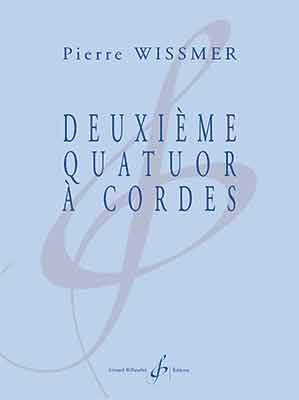
Pierre Wissmer
Deuxième quatuor à cordes
- Besetzung Streichquartett (2 Violinen, Viola und Cello)
- Komponist Pierre Wissmer
- Ausgabe Noten
- Verlag Gerard Billaudot
- Bestell-Nr. BILL9479
 Lieferzeit 4-8 Arbeitstage
inkl. MwSt.,
zzgl. Versand
Nicht in allen Ländern verfügbar. Mehr erfahren

Beschreibung:
In the first half of the 20th century, numerous Suisse Romande composers had double training in Germany then in Paris, subsequently often preserving - like Frank Martin - simultaneous ties with the Latin and Germanic poles of their country of origin.
For Geneva-born Pierre Wissmer, it was France, and France alone, that was going to serve as a home base, as much in his life as in his creative aesthetic. In fact, the latter was attached on the same level to French music, as much in his inspiration as in the clarity of writing and instrumentation.
Pierre Wissmer studied music at the Conservatory of his birthplace before leaving in 1935 to go to Paris where he first studied with Roger-Ducasse then acquired the reliability of his craft in Daniel-Lesur's counterpoint class at the Schola Cantorum. Over the years, his style, which could first be defined schematically as post-Ravelian, turned towards a more distanced relationship to tonality and a more introspective language as attest in particular his last symphonies or his organ works. However, within this evolution, the perfection and refinement of the contrapuntal writing remain a constant in Wissmer's art.
Alongside his creative career, the musician (who took French citizenship in 1958) carried out important work as a professor, which led him to teaching harmony, orchestration and composition at the Schola Cantorum, the Le Mans Conservatory (of which he would be director from 1969 to 1981) and at the Geneva Conservatory of Music.
Pierre Wissmer's output enriched all genres - with the exception of religious music - and readily refers, in instrumental music, to classical structures such as the symphony (he would compose nine, between 1938 and 1989), concerto (a domain he cultivated with delectation), sonata, trio, quartet, etc. He was also the author of a noteworthy corpus of songs and ballets, as well as several lyric works, including Marion ou la belle au tricorne, which enjoyed a real success in its Paris premiere at the Opéra-Comique in 1951.
Chamber music occupies an important place in Pierre Wissmer's catalogue. Although he willingly wrote for wind instruments, the musician did not, for all that, neglect strings to which he devoted, in particular, two quartets, the Second being the object of the present recording.
The Second String Quartet belongs to an extremely fruitful period in Wissmer's career, witnessing the birth of Marion ou la belle au tricorne (1945), Piano Concerto No.2 (1947), the song cycle La Balle au bond and the Second Symphony (1951). Here one easily detects the composer's attachment to traditional forms, and the work does not shy from a language of a neo-classical nature, tinged with a subtle polytonality, which in no way reduces the spontaneity of expr The ession or the richness of melodic invention.
Composed between September 1948 and February 1949, the Second String Quartet was first performed by the Végh Quartet on 3 June 1949 in the studios of Radio-Genève. score, which is striking in its concision and the remarkable balance of its polyphony, consists of three movements, disregarding the traditional scherzo.
It begins with an Allegro moderato in sonata form. The lovely, eloquent opening theme in G major carries on a dialogue with a second subject in D major, itself made up of two segments, one rhythmic, the other more melodic. These two elements will form the essential part of the development, the first theme appearing only fleetingly. It will be found again, considerably abridged, in a brief recapitulation that ends with an energetic coda.
A sweeping melody, entrusted to the first violin, opens the central Andante of which the first section, in D major, stands out with its generous lyricism. The second section provides contrast with its tense atmosphere, generated by very shifting tonal foundations and constant modulations. The third part brings back the initial theme, followed by a concluding episode. The movement dies out in the newfound key of D major, on a final chord in which the harmonic sounds of the cello sparkle.
The concluding Allegro, in free rondo form, brings back the key of G major. The refrain opens with a gigue motif, stated by the first violin and giving rise to a voluble first section followed by a first episode in binary rhythm. The second occurrence of the refrain is varied and takes us into D major before a second episode takes the form of a burlesque march. A new variation of the refrain, in a C major soon drowned in polytonality, precedes a third episode, a new binary episode with very pronounced rhythmic contours. The superimposition of increasingly chromatic melodic lines creates a harmonic blurring that is resolved with the final, abridged recapitulation of the refrain in G major. This goes directly into a brief coda made up of broad aggregates articulated by the four instruments, before two final concluding bars in the main key.
Jacques Tchamkerten
Translated by John Tyler Tuttle
For Geneva-born Pierre Wissmer, it was France, and France alone, that was going to serve as a home base, as much in his life as in his creative aesthetic. In fact, the latter was attached on the same level to French music, as much in his inspiration as in the clarity of writing and instrumentation.
Pierre Wissmer studied music at the Conservatory of his birthplace before leaving in 1935 to go to Paris where he first studied with Roger-Ducasse then acquired the reliability of his craft in Daniel-Lesur's counterpoint class at the Schola Cantorum. Over the years, his style, which could first be defined schematically as post-Ravelian, turned towards a more distanced relationship to tonality and a more introspective language as attest in particular his last symphonies or his organ works. However, within this evolution, the perfection and refinement of the contrapuntal writing remain a constant in Wissmer's art.
Alongside his creative career, the musician (who took French citizenship in 1958) carried out important work as a professor, which led him to teaching harmony, orchestration and composition at the Schola Cantorum, the Le Mans Conservatory (of which he would be director from 1969 to 1981) and at the Geneva Conservatory of Music.
Pierre Wissmer's output enriched all genres - with the exception of religious music - and readily refers, in instrumental music, to classical structures such as the symphony (he would compose nine, between 1938 and 1989), concerto (a domain he cultivated with delectation), sonata, trio, quartet, etc. He was also the author of a noteworthy corpus of songs and ballets, as well as several lyric works, including Marion ou la belle au tricorne, which enjoyed a real success in its Paris premiere at the Opéra-Comique in 1951.
Chamber music occupies an important place in Pierre Wissmer's catalogue. Although he willingly wrote for wind instruments, the musician did not, for all that, neglect strings to which he devoted, in particular, two quartets, the Second being the object of the present recording.
The Second String Quartet belongs to an extremely fruitful period in Wissmer's career, witnessing the birth of Marion ou la belle au tricorne (1945), Piano Concerto No.2 (1947), the song cycle La Balle au bond and the Second Symphony (1951). Here one easily detects the composer's attachment to traditional forms, and the work does not shy from a language of a neo-classical nature, tinged with a subtle polytonality, which in no way reduces the spontaneity of expr The ession or the richness of melodic invention.
Composed between September 1948 and February 1949, the Second String Quartet was first performed by the Végh Quartet on 3 June 1949 in the studios of Radio-Genève. score, which is striking in its concision and the remarkable balance of its polyphony, consists of three movements, disregarding the traditional scherzo.
It begins with an Allegro moderato in sonata form. The lovely, eloquent opening theme in G major carries on a dialogue with a second subject in D major, itself made up of two segments, one rhythmic, the other more melodic. These two elements will form the essential part of the development, the first theme appearing only fleetingly. It will be found again, considerably abridged, in a brief recapitulation that ends with an energetic coda.
A sweeping melody, entrusted to the first violin, opens the central Andante of which the first section, in D major, stands out with its generous lyricism. The second section provides contrast with its tense atmosphere, generated by very shifting tonal foundations and constant modulations. The third part brings back the initial theme, followed by a concluding episode. The movement dies out in the newfound key of D major, on a final chord in which the harmonic sounds of the cello sparkle.
The concluding Allegro, in free rondo form, brings back the key of G major. The refrain opens with a gigue motif, stated by the first violin and giving rise to a voluble first section followed by a first episode in binary rhythm. The second occurrence of the refrain is varied and takes us into D major before a second episode takes the form of a burlesque march. A new variation of the refrain, in a C major soon drowned in polytonality, precedes a third episode, a new binary episode with very pronounced rhythmic contours. The superimposition of increasingly chromatic melodic lines creates a harmonic blurring that is resolved with the final, abridged recapitulation of the refrain in G major. This goes directly into a brief coda made up of broad aggregates articulated by the four instruments, before two final concluding bars in the main key.
Jacques Tchamkerten
Translated by John Tyler Tuttle