
Claus-Steffen Mahnkopf
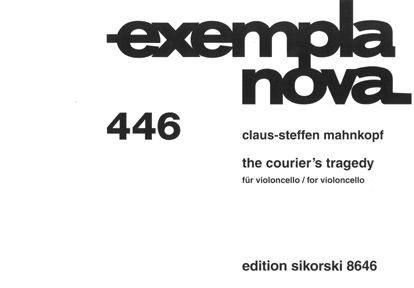
The Courier's Tragedy für Violoncello
PDF
ansehen
Claus-Steffen Mahnkopf
The Courier's Tragedy für Violoncello
- Besetzung Cello
- Komponist Claus-Steffen Mahnkopf
- Ausgabe Noten
- Verlag Sikorski Musikverlag
- Bestell-Nr. SI8646
 auf Lager
Lieferzeit 1-3 Arbeitstage
inkl. MwSt.,
zzgl. Versand
Nicht in allen Ländern verfügbar. Mehr erfahren

Beschreibung:
The Courier's Tragedy bildet einen Teil meines Pynchon-Zyklus, der folgende Werke umfasst: Hommage à Thomas Pynchon für Ensemble, Solocello und Live-Elektronik (Musik-Installation); Dauer: unendlich The Tristero System für Ensemble; Dauer: 18' The Courier's Tragedy für Violoncello solo, Dauer: 19' W.A.S.T.E. für Oboe und Live-Elektronik; Dauer: 18' D.E.A.T.H. für Achtspur-Tonband; Dauer: 12'
Ausgangspunkt des Pynchon-Zyklus ist der Roman The Crying of Lot 49 von Thomas Pynchon, den ich für einen der bedeutendsten Schriftsteller der Gegenwart halte und mit dem mich vieles verbindet, vor allem die paranoide Weltsicht auf eine durch und durch amoralisierte und entbürgerlichte Gesellschaft, wie sie sich in den Megametropolen von heute zeigt. In bewusster Absetzung von den anderen Zyklen aus der unmittelbaren Gegenwart - so zu György Kurtág, Daniel Libeskind und Zaha Hadid - geht es mir in diesem Zyklus um Härte, fast Brutalität, um die Konsequentialität von letztlich sinnlosen Prozeduren, die alles mit allem zu vermitteln scheinen, ohne dabei Bedeutung stiften zu können. Auf solche Härte antwortet das von mir bewusst als 'hässlich' gewählte Material; aber auch die kompositorischen und damit auch formalen Strategien sind an der Grenze dessen angesiedelt, was einem in guter europäischer Tradition ausgebildeten Komponisten an Verwerfungen und Verzerrungen möglich ist.
The Courier's Tragedy übersetzt die narrative Struktur des gleichnamigen Horror-Renaissance-Theaterstücks aus dem oben genannten Roman in eine mechanische Folge von Zahlen und Proportionen, die auf möglichst vielen Ebenen der Konstruktion - und zwar unabhängig davon, ob das musikalisch sinnvoll ist oder nicht - angewandt werden. Die kalte Rationalität einer komplexen Vernetzung trifft sich auf diese Weise mit einer paranoischen Sinnleere. In The Courier's Tragedy sieht sich der Violoncellist einer absurden Situation ausgesetzt: Die Partitur ist auf 12 Systemen notiert, die eine Vielfalt von Gestaltungsmöglichkeiten eröffnet und diese zugleich aufgrund interner Widersprüche zu verunmöglichen scheint. Die Souveränität des Interpreten als Herr seines Instruments wird, dem Aufbau des Theaterstücks folgend in einem Prolog, in fünf Akten und einem Epilog, systematisch unterminiert, bis am Ende das Cellospielen selber unmöglich geworden ist. Erschöpft und seiner expressiven Fähigkeiten beraubt, vibriert der Spieler ins Leere und versucht vergebens, dem Holzkorpus jene melodischen Qualitäten abzugewinnen, die die vier Saiten längst verloren haben. (Claus-Steffen Mahnkopf)
--------------------------------------------------------- The Courier's Tragedy is a part of my Pynchon Cycle, comprised of the following works: The Tristero System for Ensemble (Duration: 18'), The Courier's Tragedy für Violoncello solo (19') W.A.S.T.E. for Oboe and Live Elektronics (18') D.E.A.T.H. for Eight-track tape (12')
The starting point of the Pynchon Cycle is the novel The Crying of Lot 49 by Thomas Pynchon, who I consider one of the most important novelists of our time, and with whom I feel much in common, above all a paranoid world-view of a thoroughly amoralized and dehumanized (entbürgerlicht?) society, as can be seen in the present-day megapolis. In a conscious distancing from other cycles of the immediate present--such as those by György Kurtág, Daniel Libeskind and Zaha Hadid--I was concerned in this cycle with something hard, almost brutal, with the logical consequentiality of ultimately senseless procedures which appear to mediate everything with everything else, without being able to create thereby anything meaningful. To this 'hardness' I responded in my selection of material, consciously acknowledged as hideous; in addition, the compositional and therefore formal strategies are settled on the border of what a composer educated in the fine old European tradition might consider fractured and distorted.
The Courier's Tragedy translates the narrative structure of the Renaissance horror-play of the same name from The Crying of Lot 49 by means of a mechanical sequence of numbers and proportions, which are applied to all levels of the construction, this consciously independent of whether this was musically 'sensible' or not. The cold rationality of a complex networking here corresponds to a paranoid sense-lessness. In The Courier's Tragedy, the cellist is placed in an absurd situation: the score is notated on 12 systems, which simultaneously offer a multitude of potentials for sonic shaping and, due to their internal contradictions, appear to render their realization impossible. During the course of the theatrical piece unfolded in a prologue, five acts and an epilogue, the sovereignty of the interpreter as master of the instrument is systematically undermined, until at the end the possibility of playing the cello itself is rendered impossible. Exhausted and robbed of his expressive capabilities, the player plays in a void and attempts in vain to attain melodic quality from the wooden body, a quality that the four strings have long since surrendered. (Claus-Steffen Mahnkopf)
Ausgangspunkt des Pynchon-Zyklus ist der Roman The Crying of Lot 49 von Thomas Pynchon, den ich für einen der bedeutendsten Schriftsteller der Gegenwart halte und mit dem mich vieles verbindet, vor allem die paranoide Weltsicht auf eine durch und durch amoralisierte und entbürgerlichte Gesellschaft, wie sie sich in den Megametropolen von heute zeigt. In bewusster Absetzung von den anderen Zyklen aus der unmittelbaren Gegenwart - so zu György Kurtág, Daniel Libeskind und Zaha Hadid - geht es mir in diesem Zyklus um Härte, fast Brutalität, um die Konsequentialität von letztlich sinnlosen Prozeduren, die alles mit allem zu vermitteln scheinen, ohne dabei Bedeutung stiften zu können. Auf solche Härte antwortet das von mir bewusst als 'hässlich' gewählte Material; aber auch die kompositorischen und damit auch formalen Strategien sind an der Grenze dessen angesiedelt, was einem in guter europäischer Tradition ausgebildeten Komponisten an Verwerfungen und Verzerrungen möglich ist.
The Courier's Tragedy übersetzt die narrative Struktur des gleichnamigen Horror-Renaissance-Theaterstücks aus dem oben genannten Roman in eine mechanische Folge von Zahlen und Proportionen, die auf möglichst vielen Ebenen der Konstruktion - und zwar unabhängig davon, ob das musikalisch sinnvoll ist oder nicht - angewandt werden. Die kalte Rationalität einer komplexen Vernetzung trifft sich auf diese Weise mit einer paranoischen Sinnleere. In The Courier's Tragedy sieht sich der Violoncellist einer absurden Situation ausgesetzt: Die Partitur ist auf 12 Systemen notiert, die eine Vielfalt von Gestaltungsmöglichkeiten eröffnet und diese zugleich aufgrund interner Widersprüche zu verunmöglichen scheint. Die Souveränität des Interpreten als Herr seines Instruments wird, dem Aufbau des Theaterstücks folgend in einem Prolog, in fünf Akten und einem Epilog, systematisch unterminiert, bis am Ende das Cellospielen selber unmöglich geworden ist. Erschöpft und seiner expressiven Fähigkeiten beraubt, vibriert der Spieler ins Leere und versucht vergebens, dem Holzkorpus jene melodischen Qualitäten abzugewinnen, die die vier Saiten längst verloren haben. (Claus-Steffen Mahnkopf)
--------------------------------------------------------- The Courier's Tragedy is a part of my Pynchon Cycle, comprised of the following works: The Tristero System for Ensemble (Duration: 18'), The Courier's Tragedy für Violoncello solo (19') W.A.S.T.E. for Oboe and Live Elektronics (18') D.E.A.T.H. for Eight-track tape (12')
The starting point of the Pynchon Cycle is the novel The Crying of Lot 49 by Thomas Pynchon, who I consider one of the most important novelists of our time, and with whom I feel much in common, above all a paranoid world-view of a thoroughly amoralized and dehumanized (entbürgerlicht?) society, as can be seen in the present-day megapolis. In a conscious distancing from other cycles of the immediate present--such as those by György Kurtág, Daniel Libeskind and Zaha Hadid--I was concerned in this cycle with something hard, almost brutal, with the logical consequentiality of ultimately senseless procedures which appear to mediate everything with everything else, without being able to create thereby anything meaningful. To this 'hardness' I responded in my selection of material, consciously acknowledged as hideous; in addition, the compositional and therefore formal strategies are settled on the border of what a composer educated in the fine old European tradition might consider fractured and distorted.
The Courier's Tragedy translates the narrative structure of the Renaissance horror-play of the same name from The Crying of Lot 49 by means of a mechanical sequence of numbers and proportions, which are applied to all levels of the construction, this consciously independent of whether this was musically 'sensible' or not. The cold rationality of a complex networking here corresponds to a paranoid sense-lessness. In The Courier's Tragedy, the cellist is placed in an absurd situation: the score is notated on 12 systems, which simultaneously offer a multitude of potentials for sonic shaping and, due to their internal contradictions, appear to render their realization impossible. During the course of the theatrical piece unfolded in a prologue, five acts and an epilogue, the sovereignty of the interpreter as master of the instrument is systematically undermined, until at the end the possibility of playing the cello itself is rendered impossible. Exhausted and robbed of his expressive capabilities, the player plays in a void and attempts in vain to attain melodic quality from the wooden body, a quality that the four strings have long since surrendered. (Claus-Steffen Mahnkopf)