
Antoni Cofalik
Scales
2-, 3- and 4-Octave for Violin


Antoni Cofalik
Scales
2-, 3- and 4-Octave for Violin
- Besetzung Violine
- Ausgabe Noten
- Komponist Antoni Cofalik
- Verlag PWM Edition
- Bestell-Nr. PWM11287010
inkl. MwSt.,
zzgl. Versand
 auf Lager
|
Lieferzeit 1-3 Arbeitstage
Voraussichtliche Lieferung zwischen
13.11.2026
und
17.11.2026.

Beschreibung:
In the first part of this collection we find selected two-octave scales in first position intended for beginners. Something new when compared to those arrangements in use is the introduction of broken chords for the harmonic triads (T-S-D). This reinforces the young violinists sense of function, developing harmonic hearing. A feature of our publication is our seeking rhythmic regularity and proportionality of individual sections of the scale. This type note layout gets the player used to metrical-rhythmical playing and teaches formal discipline.
Part II two-octave scales with a change of position, more extensive passages and double-stopping is more demanding. Smooth transition from upward direction of movement to downward (without stopping on the highest note) gives the scales 'melodiousness'.
I based the three-octave studies (Part III) on Das Skalensystem by Carl Flesch, expanding them in the direction virtuosic fluency. Not being an advocate of the exclusive use of single-name scales (as they are often played), I have divided major from minor and placed them in separate blocks. Starting both blocks from the lowest note (g) takes gradation of difficulty into account - climbing to ever higher positions.
Selected four-octave scales (Part IV), without the 'flourishes', are intended for more ambitious pupils, students, as well as for mature violinists who want to maintain maximum technical capacity for many years.
Two-octave scales on the G string (Part V) are excellent training for changes of position (smooth movement of the hand around the neck) and a way to quickly warm up. I resigned from the carrying the latter onto the other strings, believing that the ability to play in high positions on the D and A strings is not as essential as on the G string (on the E string we get it in four octave scales and three octave scales that begin higher up). [Antoni Cofalik].
Kunden bewerteten diesen Artikel:
alle-noten.de: Notenversand seit 1969

Bereits seit 1969 vertrauen uns über 500.000 Kunden. Mit einer riesigen Auswahl an über 1.000.000 Noten sind wir einer der größten Anbieter Europas. Durch unseren großen Lagerstand können wir Noten oft innerhalb von 24 Stunden versenden. Egal welche Noten Sie suchen: bei uns sind Sie richtig!
Ihre Stefanie Reichert
Leitung Kundenbetreuung
Andere Kunden kauften auch:

- Violine
- Noten
- Antoni Cofalik
-
auf Lager
|
Lieferzeit 1-3 Arbeitstage

Antoni Cofalik
- Violine und Klavier
- Noten
-
auf Lager
|
Lieferzeit 1-3 Arbeitstage

- Violine
- Noten
-
auf Lager
|
Lieferzeit 1-3 Arbeitstage

- Streichtrio (2 Violinen und Cello)
- Spielpartitur(en)
-
auf Lager
|
Lieferzeit 1-3 Arbeitstage

Antoni Cofalik
- Violine
- Noten
-
Lieferzeit 2-4 Wochen
- Violine
- Noten
-
auf Lager
|
Lieferzeit 1-3 Arbeitstage

- Violine und Klavier
- Klavierpartitur und Stimme(n) und Online Audio
-
auf Lager
|
Lieferzeit 1-3 Arbeitstage
- Auch als Download verfügbar!

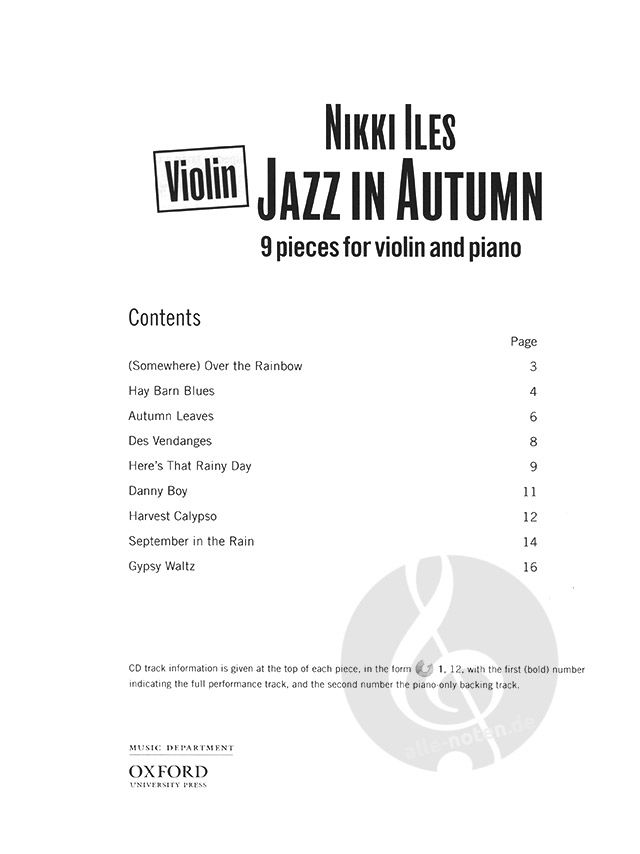
9 pieces for violin and piano
- Violine und Klavier
- Klavierpartitur und Stimme(n) und CD
- Nikki Iles
-
Lieferzeit 2-4 Arbeitstage

- Violine
- Noten
-
auf Lager
|
Lieferzeit 1-3 Arbeitstage

Robert Pracht
- Violine
- Noten
-
auf Lager
|
Lieferzeit 1-3 Arbeitstage

- Violine
- Noten
-
auf Lager
|
Lieferzeit 1-3 Arbeitstage

- Violine
- Noten
-
auf Lager
|
Lieferzeit 1-3 Arbeitstage

Antoni Cofalik
- Violine
- Noten
-
auf Lager
|
Lieferzeit 1-3 Arbeitstage



Andrea Holzer-Rhomberg
- Violine
- Noten und Online Audio
-
auf Lager
|
Lieferzeit 1-3 Arbeitstage