
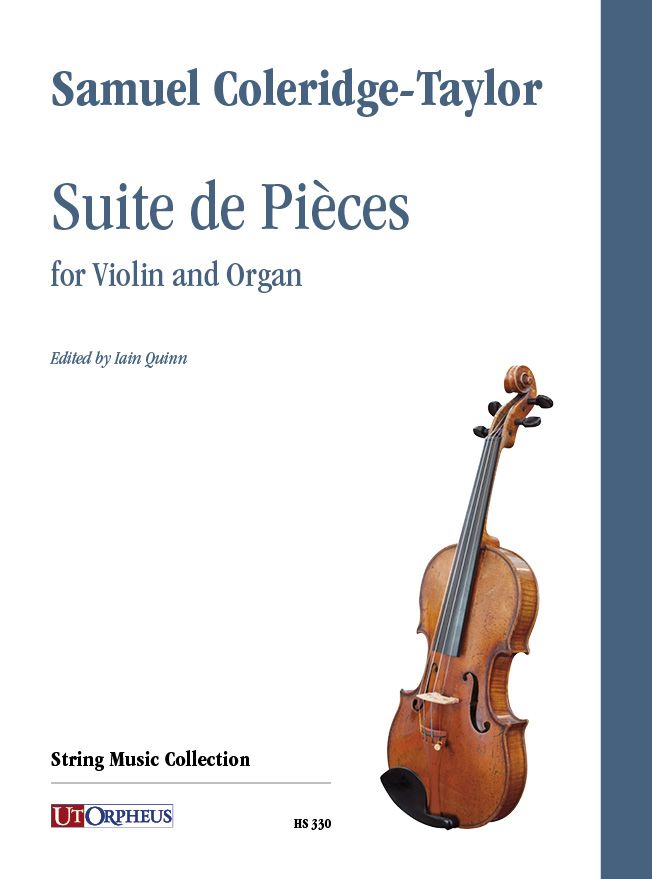
Samuel Coleridge-Taylor
Suite de Pieces
for Violin and Organ
PDF
ansehen
Samuel Coleridge-Taylor
Suite de Pieces
for Violin and Organ
- Besetzung Violine und Orgel
- Komponist Samuel Coleridge-Taylor
- Herausgeber Iain Quinn
- Ausgabe Partitur und Stimmen
- Verlag UT Orpheus Edizioni
- Bestell-Nr. ORPH-HS330
 Lieferzeit 1-2 Wochen

Beschreibung:
The period of composition (ca. 1893) for the Suite de Pièces for violin and piano or violin and organ was especially productive for Samuel Coleridge-Taylor (1875-1912) in the realm of chamber music. Unpublished works include a piano quintet, clarinet sonata, nonet, piano trio, and a piano sonata.
It is notable that the different versions of the Suite for piano and organ are so contrasting. Typically, pieces in this genre that exist in versions for piano and organ have little that separate them in terms of musical content. However, Coleridge-Taylor not only approaches each keyboard instrument quite differently but conceived the violin part with notable melodic differences. This can be considered exceptional as they were both issued by the same publisher within a close timeframe.
Coleridge-Taylor would have been very familiar with the organ from his early church experience as a boy in addition to studies at the Royal College of Music with Walter Alcock. His writing is consistently idiomatic for the instrument. The few registrational directions in the first edition, assuming they are by Coleridge-Taylor, demonstrate an understanding of the need to balance the organ part with the violin part so that the organ is not too loud. Rather than numbering the manuals I and II, with II being the quieter manual, the score indicates Swell and Choir but there is no requirement for the Great to be used. There are also extended sections where no manual indication is given at all. Whether the registration markings were made by Coleridge-Taylor or an editor at Schott is unclear but the indication for a Choir manual suggests not so much the need for an organ of three manuals but an instrument with a range of foundational colours for writing that is often accompanimental in nature.
It is notable that the different versions of the Suite for piano and organ are so contrasting. Typically, pieces in this genre that exist in versions for piano and organ have little that separate them in terms of musical content. However, Coleridge-Taylor not only approaches each keyboard instrument quite differently but conceived the violin part with notable melodic differences. This can be considered exceptional as they were both issued by the same publisher within a close timeframe.
Coleridge-Taylor would have been very familiar with the organ from his early church experience as a boy in addition to studies at the Royal College of Music with Walter Alcock. His writing is consistently idiomatic for the instrument. The few registrational directions in the first edition, assuming they are by Coleridge-Taylor, demonstrate an understanding of the need to balance the organ part with the violin part so that the organ is not too loud. Rather than numbering the manuals I and II, with II being the quieter manual, the score indicates Swell and Choir but there is no requirement for the Great to be used. There are also extended sections where no manual indication is given at all. Whether the registration markings were made by Coleridge-Taylor or an editor at Schott is unclear but the indication for a Choir manual suggests not so much the need for an organ of three manuals but an instrument with a range of foundational colours for writing that is often accompanimental in nature.