
Wolfgang Amadeus Mozart
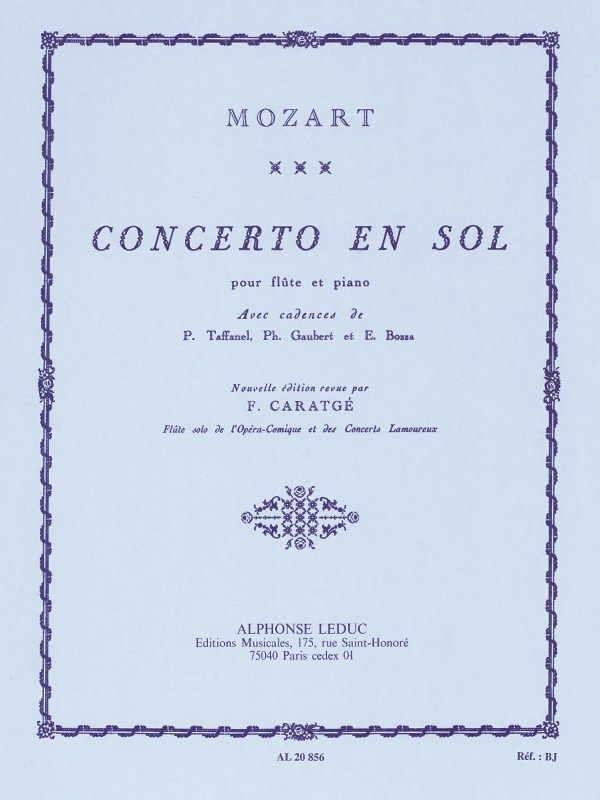
Concerto en Sol
Flute Trav. et Piano (Cadences Taffanel/gaubert/bozza)
Wolfgang Amadeus Mozart
Concerto en Sol
Flute Trav. et Piano (Cadences Taffanel/gaubert/bozza)
- Besetzung Querflöte und Klavier
- Komponist Wolfgang Amadeus Mozart
- Ausgabe Noten
- Verlag Alphonse Leduc
- Bestell-Nr. AL20856
 Lieferzeit 3-6 Arbeitstage
inkl. MwSt.,
zzgl. Versand
Nicht in allen Ländern verfügbar. Mehr erfahren

Beschreibung:
Wolfgang Amadeus Mozart's (1756-1791) Flute Concerto in G was written by the composer in 1778. The Concerto remains widely studied and performed on the Flute, making it one of the mostimportant Concerti in the instrument's repertoire.
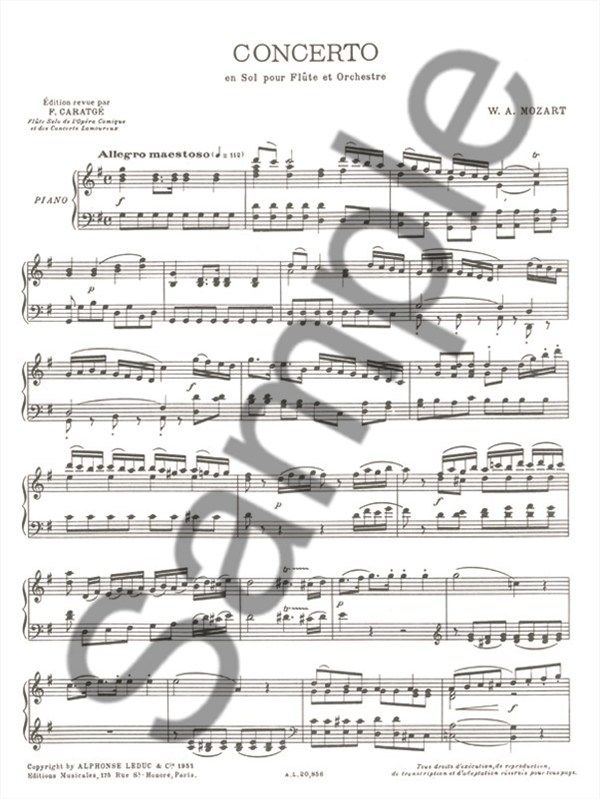
Concerto in G is in three movements; 1. Allegro maestoso, 2. Adagio ma non troppo, and 3. Rondo: Tempo di Menuetto. The first and last movements arein the tonic key, whilst the second movement is in the subdominant key of D major. A Dutch flautist of the time, Ferdinand de Jean, commissioned Mozart for four Flute quartets and three Flute concerti. However, thecomposer, who famously disliked the Flute, only completed three quartets and two concertos. Instead of composing a second concerto, Mozart rearranged his Oboe Concerto, with substantial changes for itto fit with the Flute. This edition of Mozart's Concerto in G includes cadences by virtuosos Taffanel, Gaubert and Bozza, making for an unmissable version of the famed work.
Concerto in G is in three movements; 1. Allegro maestoso, 2. Adagio ma non troppo, and 3. Rondo: Tempo di Menuetto. The first and last movements arein the tonic key, whilst the second movement is in the subdominant key of D major. A Dutch flautist of the time, Ferdinand de Jean, commissioned Mozart for four Flute quartets and three Flute concerti. However, thecomposer, who famously disliked the Flute, only completed three quartets and two concertos. Instead of composing a second concerto, Mozart rearranged his Oboe Concerto, with substantial changes for itto fit with the Flute. This edition of Mozart's Concerto in G includes cadences by virtuosos Taffanel, Gaubert and Bozza, making for an unmissable version of the famed work.