
Wolfgang Amadeus Mozart, Bob Zottola
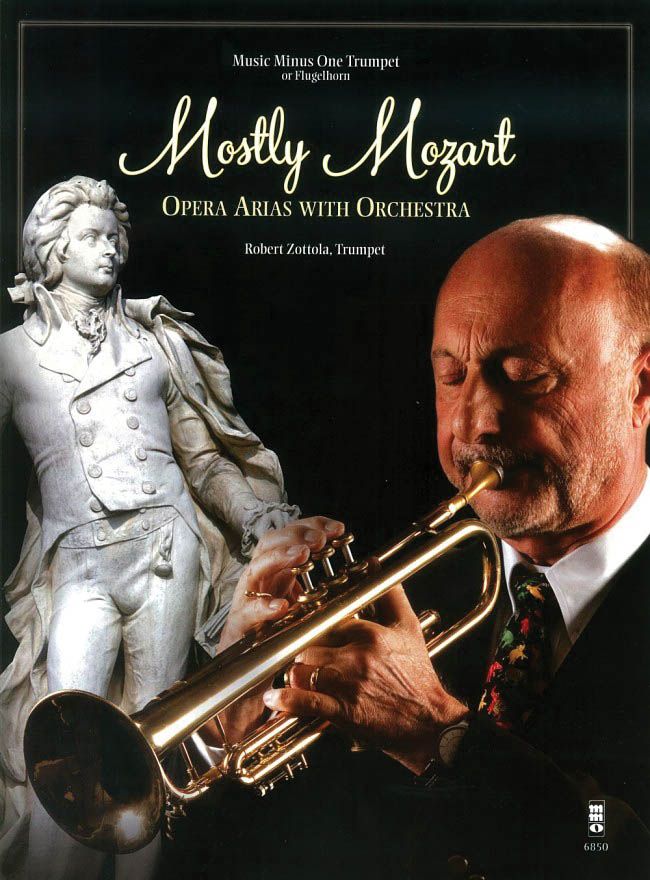
Mostly Mozart
Opera Arias with Orchestra

Demo
anhören
Wolfgang Amadeus Mozart, Bob Zottola
Mostly Mozart
Opera Arias with Orchestra
- Besetzung Trompete
- Komponist Wolfgang Amadeus Mozart Bob Zottola
- Ausgabe Noten und CD
- Verlag Music Minus One (MMO)
- Bestell-Nr. MMO6850
 auf Lager
Lieferzeit 1-3 Arbeitstage
inkl. MwSt.,
zzgl. Versand
Nicht in allen Ländern verfügbar. Mehr erfahren

Beschreibung:
Well, as many of you know Mostly Mozart is a summer series of concerts held at Lincoln Center in New York City. It began in 2002 and is projected to continue until at least 2017!
I admit that I've always considered it such a catchy title that I couldn't resist using it for this Music Minus One of mostly Mozart operatic arias. However, the true impetus for creating this album which follows in the footsteps of my Arban's Opera Arias for Trumpet & Orchestra MMO 6849 is a long and deep love for the music of Wolfgang Amadeus Mozart.
Unfortunately, he didn't write any solo pieces for the trumpet of that time period since it was a rather primitive instrument. The French horn on the other hand, Mozart found intriguing enough to compose his marvelous horn concerti. Although it's in the brass instrument family, because of it's unique timbre it find its roles many times with the woodwinds. In my deep, dark past I spent some time with the French horn even playing the horn concerti and considered doubling on the horn! It was not practical in the midst of my busy career in NYC but the Flugelhorn with its somewhat, similar tone quality is an easy double and expected of a trumpet player. In fact, the Flugelhorn had the nick-name of the 'poor-man's French horn'!
The reason I went into detail on this is because in order to adapt these vocal pieces instrumentally, I chose the 'Flugel' over the trumpet when warmth, lyricism and a mellower 'voice' was required.
Okay, now before we get into the arias, a brief warning about the tuning for this album.
The orchestras in Eastern Europe tune much higher than A=440, in fact in order to tune to these tracks that were recorded by the Plovdiv Philharmonic, I either pushed my tuning slide all the way in or only about a 32nd of an inch out! Even so, there are places where I'm a tad below pitch. I say this so you are not surprised or frustrated!
The exception is Mozart's Vocalise #1 which is a duet and therefore me with me!
The first aria Der Vogelfanger bin ich ja ('I am the bird-catcher, yes') from The Magic Flute is in Arban's Art Of Phrasing as an excerpt (#123) but here it is in its entirety with all three verses. The baritone Papageno is a bird catcher and the repetitive flute phrase accentuates that theme. He's dressed as a bird and complaining about his life as a bird-catcher with no wife or girl-friend.
If you've purchased any of my MMOs with songs from the Great American Song Book, you know that I'm an advocate of learning the lyrics and hence the stories of the songs in order to express the music with emotion.
However, working with these great arias, I had to settle for just a basic understanding of the roles, dramatically speaking. Of course, if you're curious you are invited to research the operatic settings for these arias. With that said, my approach with Papageno's whimsical aria was simply to enter a bit more intensity to each subsequent verse.
I admit that I've always considered it such a catchy title that I couldn't resist using it for this Music Minus One of mostly Mozart operatic arias. However, the true impetus for creating this album which follows in the footsteps of my Arban's Opera Arias for Trumpet & Orchestra MMO 6849 is a long and deep love for the music of Wolfgang Amadeus Mozart.
Unfortunately, he didn't write any solo pieces for the trumpet of that time period since it was a rather primitive instrument. The French horn on the other hand, Mozart found intriguing enough to compose his marvelous horn concerti. Although it's in the brass instrument family, because of it's unique timbre it find its roles many times with the woodwinds. In my deep, dark past I spent some time with the French horn even playing the horn concerti and considered doubling on the horn! It was not practical in the midst of my busy career in NYC but the Flugelhorn with its somewhat, similar tone quality is an easy double and expected of a trumpet player. In fact, the Flugelhorn had the nick-name of the 'poor-man's French horn'!
The reason I went into detail on this is because in order to adapt these vocal pieces instrumentally, I chose the 'Flugel' over the trumpet when warmth, lyricism and a mellower 'voice' was required.
Okay, now before we get into the arias, a brief warning about the tuning for this album.
The orchestras in Eastern Europe tune much higher than A=440, in fact in order to tune to these tracks that were recorded by the Plovdiv Philharmonic, I either pushed my tuning slide all the way in or only about a 32nd of an inch out! Even so, there are places where I'm a tad below pitch. I say this so you are not surprised or frustrated!
The exception is Mozart's Vocalise #1 which is a duet and therefore me with me!
The first aria Der Vogelfanger bin ich ja ('I am the bird-catcher, yes') from The Magic Flute is in Arban's Art Of Phrasing as an excerpt (#123) but here it is in its entirety with all three verses. The baritone Papageno is a bird catcher and the repetitive flute phrase accentuates that theme. He's dressed as a bird and complaining about his life as a bird-catcher with no wife or girl-friend.
If you've purchased any of my MMOs with songs from the Great American Song Book, you know that I'm an advocate of learning the lyrics and hence the stories of the songs in order to express the music with emotion.
However, working with these great arias, I had to settle for just a basic understanding of the roles, dramatically speaking. Of course, if you're curious you are invited to research the operatic settings for these arias. With that said, my approach with Papageno's whimsical aria was simply to enter a bit more intensity to each subsequent verse.
-
Der Vogelfänger bin ich ja
-
O Isis und Osiris
-
Voi, che sapete che cosa e amor
-
Tardi s'avvede d'un Tradimento
-
Smanie Implacabili
-
Fin ch'han dal vino
-
Deh vieni alla finestra
-
No, la morte io non pavento
-
Sciocco...qual piacer
-
Ave Maria
-
Vocalise No. 1
Kunden bewerteten diesen Artikel:
Herstellerinformationen:
Faber Music Distribution Ltd
Burnt Mill
CM20 2HX
Harlow, Essex
United Kingdom
Andere Kunden kauften auch:
- Trompete
- Noten und CD
-
auf Lager
Lieferzeit 1-3 Arbeitstage
- Trompete
- Noten und CD
-
auf Lager
Lieferzeit 1-3 Arbeitstage


Concert Band Favorites with Orchestra
- Trompete
- Noten und CD
-
auf Lager
Lieferzeit 1-3 Arbeitstage
- Trompete
- Noten und CD
-
Lieferzeit 2-4 Wochen
- Trompete
- Noten und CD
-
auf Lager
Lieferzeit 1-3 Arbeitstage